Match smoke CADR to the room, then compare media
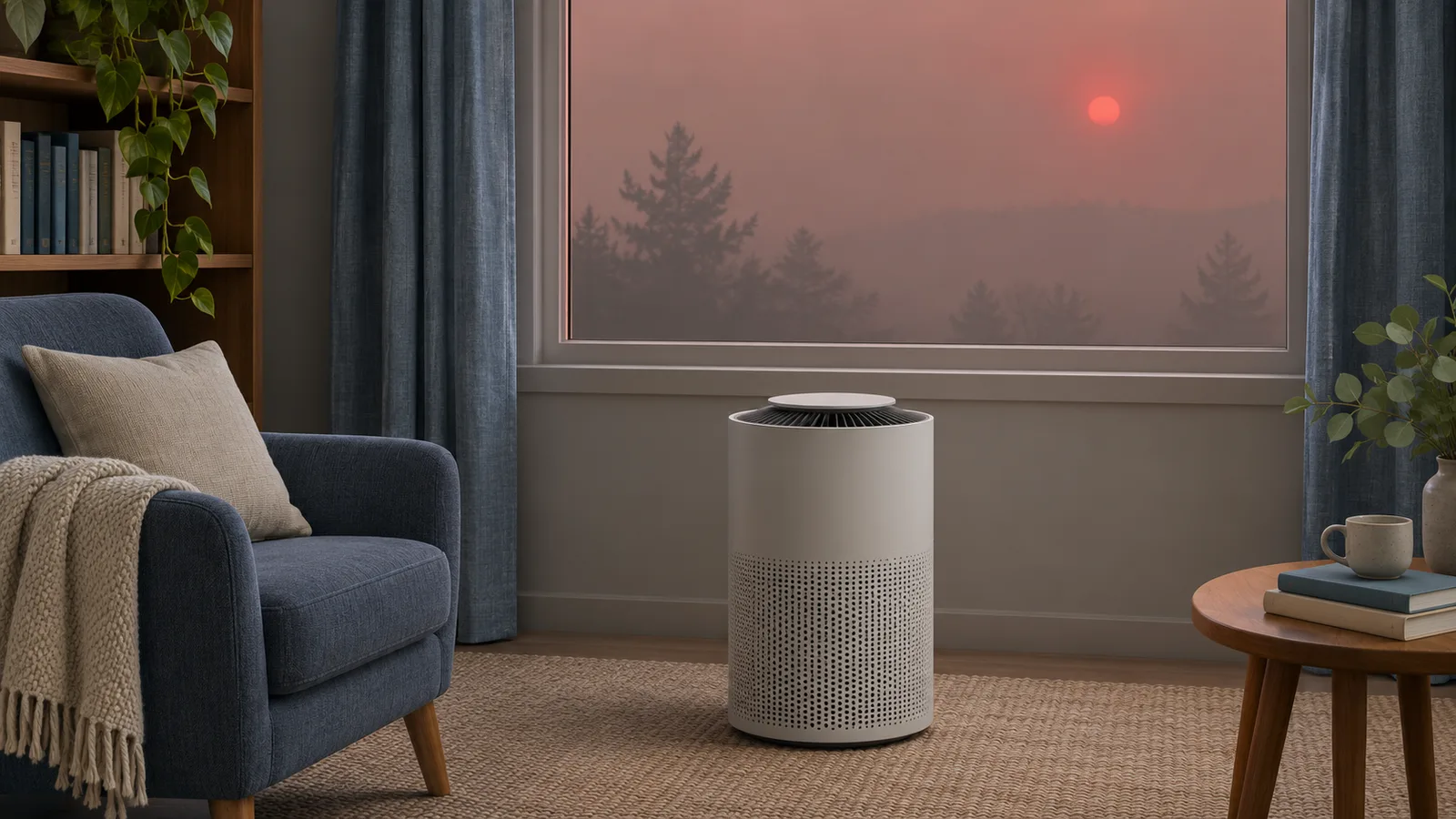
Wildfire smoke can contain particles and gases. A particle filter and gas-removal medium serve different purposes: EPA recommends a portable air cleaner with a smoke Clean Air Delivery Rate (CADR) at least two-thirds of the room’s floor area in square feet. For gases, EPA advises choosing a unit with activated carbon or another filter designed for gases. Neither label alone establishes removal of every pollutant or a health outcome. Follow local air-quality and evacuation instructions.
The table separates a smoke CADR from generic airflow. “Not listed” means the reviewed manufacturer source did not provide a comparable smoke CADR; it is not a zero rating. Filter options and replacement intervals can vary by model and use.
Five models with manufacturer-documented filter details
| Model | Smoke CADR | Particle filter | Gas/odor media in cited model/configuration | Replacement information |
|---|---|---|---|---|
| Coway Airmega 400 | 328 CFM | Max2 composite HEPA filter | Max2 combines activated carbon and HEPA | Manufacturer lists about 1 year for the Max2 set |
| Austin Air HealthMate | Not listed in reviewed source | Manufacturer-described HEPA | Up to 15 lb carbon and zeolite, depending on configuration | Check current model/filter instructions |
| IQAir HealthPro Plus | Not listed; 300 CFM maximum air delivery is not a smoke CADR | HyperHEPA H12/13 | V5-Cell: granulated activated carbon and impregnated activated alumina; manufacturer lists 5 lb | Manufacturer’s stated estimates: prefilter about 18 months, gas filter about 2 years, main filter about 4 years under specified daily use; varies with pollution |
| Winix 5500-2 | Confirm the current model’s AHAM-listed smoke CADR | True HEPA per manufacturer | Washable AOC carbon filter per model instructions | Follow the 5500-2 manual; do not substitute another model’s part or interval |
| Winix 5510 | 253 CFM | True HEPA | AOC carbon filter | Manufacturer lists 12 months for HEPA and AOC filters; conditions vary |
CADR figures are not directly interchangeable with maximum airflow, and room-size labels use specified assumptions. Confirm the precise model, filter type, and certification for the unit being purchased. The 5510 product page lists one room size while its manual and other displays may use a different sizing presentation; this comparison therefore relies on its stated smoke CADR, not a room-coverage claim.
Estimate five-year filter and electricity costs
Prices change, and manufacturers offer multiple filter configurations. Calculate from the current price for the exact replacement filter and the use assumptions you expect:
five-year filter cost = current replacement-set price × planned replacements over 60 months
five-year electricity cost = measured watts ÷ 1,000 × hours used × electricity rate
Use the maker’s replacement guidance, not an assumed common lifespan. Where the maker publishes a range or use-dependent estimate, show the range and conditions; replace the filter more often if the manual or conditions require it. This page does not provide a market-wide price ranking.
Set up and operate a cleaner safely
- Choose a room-sized unit using its smoke CADR; higher ceilings or more open floor plans may call for more capacity.
- Keep the intake and outlet clear and follow the exact manual for placement and filter changes.
- Check the cleaner’s ozone certification and technology. EPA advises against electronic air cleaners for smoke removal because effectiveness is uncertain and they may produce ozone.
- Keep spare filters available before smoke season and monitor local air-quality guidance.
- A portable air cleaner is one part of a clean-room plan; use other exposure-reduction steps and follow evacuation instructions.
Common questions
Does HEPA alone remove wildfire gases and odors?
Particle HEPA filtration and gas filtration are different. EPA recommends activated carbon or another gas-specific filter when gas removal is a goal. Media, capacity, and performance differ, and no generic HEPA label proves removal of every gas.
How do I size a purifier for wildfire smoke?
Start with smoke CADR. EPA’s rule of thumb is a smoke CADR at least two-thirds of room area in square feet; account for ceiling height, layout, placement, and the maker’s instructions as well.
Can the purifier make a home safe during wildfire smoke?
No single appliance guarantees safety. Use official air-quality and evacuation guidance, reduce outdoor-air entry when advised, and treat filtration as one exposure-reduction layer.
What does a filter replacement cost over five years?
Use the current price and replacement interval for the exact model and media option. Multiply the filter-set price by planned replacements over 60 months, then add electricity from measured power and local rates. Prices and intervals can change.
What is the fifth model in this comparison?
The Winix 5510 is included because Winix publishes its U.S. smoke CADR and filter details. The listed 253 CFM is the manufacturer’s model-specific figure, not a ranking or a promise for a particular room.
Compare room sizing and replacement costs
Use the five-year air purifier cost calculator action with the current filter price and your expected operating schedule. For the room-sizing method, see the HEPA air purifier CADR sizing guide.
Coway Airmega 400 Dual-Intake True HEPA Air Purifier
Why it fits One model in this source-linked comparison; confirm the exact Coway model, included filter set, current price, and replacement-filter details before purchase.
Key trade-off In Smart Auto mode, the Airmega 400 dims its lights and drops to sleep speed in a dark room—during heavy overnight wildfire smoke, override Smart mode and lock the fan manually on Speed 2 or Speed 3 so indoor air stays scrubbed while you sleep.
Specifications & research
Model alternative. Source records checked on 2026-11-16. Manufacturer research, not hands-on testing.
- Room coverage CADR
- Up to 145 m² (1,560 sq ft) (2 ACH) / ~350 CFM Smoke CADR · Source checked 2026-11-16
- Filtration architecture
- Dual Washable Pre-Filters + Dual Max2 (True HEPA + Carbon Pellets) · Source checked 2026-11-16
- Power consumption
- 64 Watts Max (Speed 3) / ~22W (Speed 2) / ~12W (Speed 1) · Source checked 2026-11-16
Manufacturer documentation. Confirm exact Coway model specifications and household safety limits before buying.