In this guideJump to a section
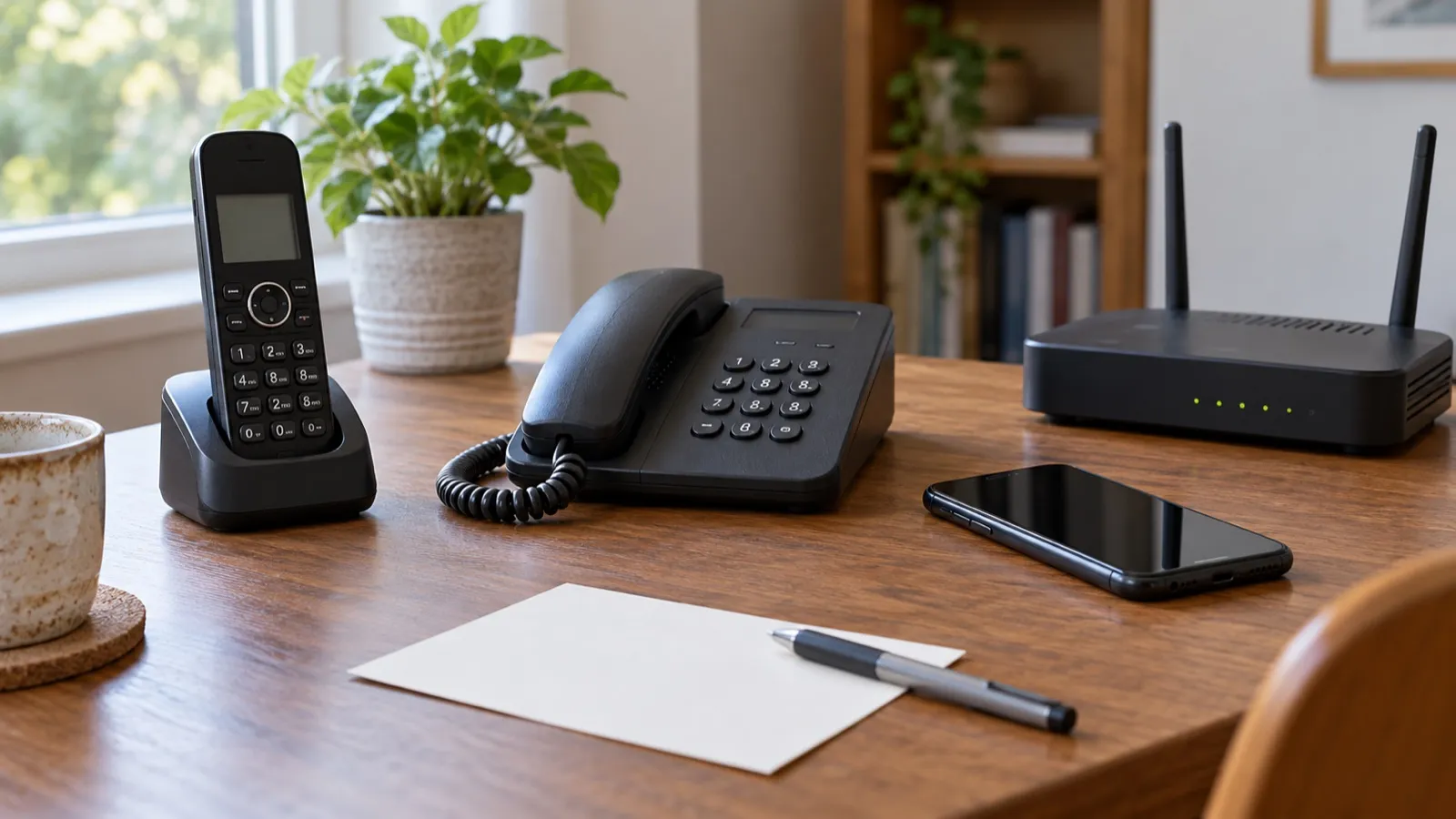
“Landline” describes how people use a phone, not necessarily how voice reaches the home. The line may be traditional copper, or the service may arrive through a powered cable or fiber gateway. A cordless handset also needs its base powered. Ask the provider what is installed at your address before counting on a phone as an outage backup.
Worked Power and Voltage Calculations
Traditional copper landlines operate on a -48V DC loop current supplied directly by the telephone central office battery bank, which remains operational even during multi-day commercial grid outages.
Physics and Electrical Comparison:
- Copper Loop: 48V DC loop current powers standard corded analog phones directly without home electrical outlets.
- Cable/Fiber Digital Voice (VoIP): Requires an Optical Network Terminal (ONT) or cable modem drawing 10W to 25W of AC power. Without a local UPS battery backup, voice and 911 service drop instantly when AC power fails.
- Runtime Math for Gateway UPS: A 120 Wh mini-UPS powering a 15W fiber ONT/router combination provides approximately: Runtime = 120 Wh ÷ 15W ≈ 8 hours
Provider checklist
| Service as supplied | What may need power inside the home | What can still fail outside | Who Should Skip It |
|---|---|---|---|
| Copper-fed wired voice | A corded phone may not need a separate home power adapter; cordless bases and added gateways do | Cable damage, local provider equipment, or loss of service; verify the exact line and provider plan | Households where traditional copper lines have been fully retired by telecom carriers. |
| Voice over cable or fiber gateway | Modem or ONT, router if required, gateway, and cordless base | Provider network, neighborhood node, central equipment, or upstream internet/voice path | Users relying solely on unbacked cable gateways during extended regional winter storms. |
| Internet VoIP from a separate provider | Broadband modem/ONT, router, any required adapter, and handset base | Broadband provider, VoIP provider, local power at either network, or account/service issue | Residents without broadband redundancy or reliable backup power generation. |
| Cellular calling | The phone and its charging path | Coverage, tower or backhaul power, congestion, and carrier network availability | Households in rural or topographic dead zones without cellular booster equipment. |
These are dependency questions, not a guarantee that one service type is more reliable. Copper can be damaged, VoIP can lose the broadband path, and cellular service can be unavailable or congested. A battery on a router does not back up provider equipment outside the home. The FCC’s fixed-voice backup-power order concerns defined services and provider duties; it does not promise that every device or network remains available.
Ask the provider before the next outage
Contact the company using the number on your bill or its official website. Ask:
- What technology delivers voice to this address: copper, cable, fiber, fixed wireless, or internet VoIP?
- Which boxes in the home must remain powered, including an ONT, modem, router, gateway, or phone adapter?
- Does the provider supply or sell a backup battery for this exact service, and what does its documented rating mean (standby or talk time)?
- What are the current replacement and maintenance instructions, and how do I know the backup is depleted?
- Does the service have a separate alert or 911 limitation that applies to this device or account?
- If the provider network fails, what alternative contact path do you recommend for this area?
Record the exact device labels, location, power source, manual, and provider answer. Do not estimate backup duration from the battery’s physical size or a display alone.