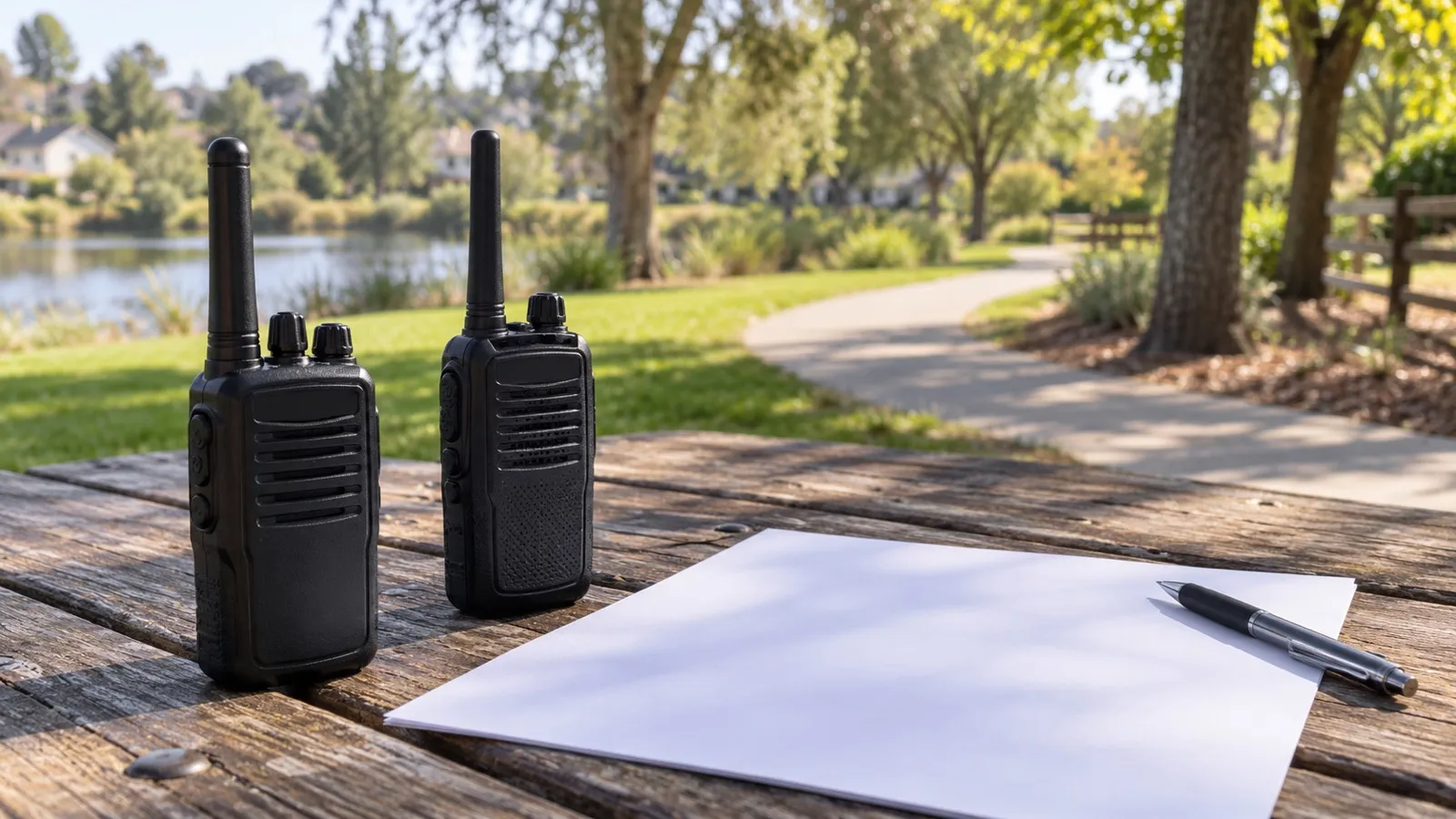
When cellular networks and internet connectivity collapse during a major winter storm, wildfire, or grid outage, households require independent local communications. The Family Radio Service (FRS) and General Mobile Radio Service (GMRS) occupy overlapping Ultra High Frequency (UHF) spectrum around 462 MHz to 467 MHz, but they differ sharply regarding FCC licensing requirements, transmitter power limits, and repeater capabilities. Selecting the right service requires evaluating your neighborhood topography and legal operating parameters.
RF Propagation and Power Calculations
Understanding radio performance in residential areas requires examining UHF propagation physics and power output limits.
Worked RF Propagation and Power Calculations:
- Frequency Band: UHF 462 MHz to 467 MHz (Wavelength λ ≈ 0.65 meters)
- FRS Power Limit: 0.5W to 2.0W Effective Radiated Power (ERP); fixed antennas
- GMRS Power Limit: Up to 50W ERP on main channels; detachable antennas and repeater support
- Free Space Path Loss over 2 miles: FSPL ≈ 104 dB
UHF radio waves behave essentially as line-of-sight signals. Concrete buildings, dense evergreen foliage, and rolling hills attenuate UHF signals severely. While box packaging often boasts “36-mile range,” real-world suburban household communication between handheld units typically spans 0.5 to 1.5 miles unless utilizing high-gain GMRS mobile radios or repeater towers.
Household Radio Fit and Decision Matrix
Use the decision matrix below to evaluate whether FRS or GMRS aligns with your emergency communication plan.
| Evaluation Criteria | Family Radio Service (FRS) | General Mobile Radio Service (GMRS) | Who Should Skip It / Operating Limit |
|---|---|---|---|
| FCC Licensing | None required; open to all operators | 35 USD fee; covers licensee and immediate family | Skip GMRS if adults refuse to register or hold call sign. Limit: 10-year renewal. |
| Transmitter Power | 0.5W to 2W ERP maximum | Up to 50W ERP on main channels | Skip FRS if bridging distances > 2 miles through rolling terrain. |
| Antenna Flexibility | Fixed, non-removable antennas only | Removable antennas, mobile antennas, base stations | Skip detachable-antenna radios on FRS channels (illegal use). |
| Repeater Access | Not permitted on repeater channels | Permitted on shared GMRS repeater pairs | Skip repeater use without proper PL/DCS tone programming. |
Household Radio Fit
Record your neighborhood radio test results and licensing decisions in the tracking table below:
| Record Field | What to Record | Why It Matters |
|---|---|---|
| Chosen Service | FRS or GMRS based on household needs | Ensures legal compliance under FCC Part 95 rules. |
| FCC Call Sign | GMRS license call sign (if applicable) | Required for station identification during transmissions. |
| Tested Route | Specific path from home to family meeting point | Confirms actual propagation through local terrain. |
| Radio Models | Exact brand and certified model numbers | Verifies equipment certification for the chosen service. |
| Channel Plan | Designated household emergency channel and CTCSS tone | Establishes protocol for family check-ins during outages. |
Comprehensive Radio Deployment and Operating Protocols
Implementing an emergency radio plan requires hands-on testing rather than relying on theoretical manufacturer specifications. Purchase a pair of radios and execute a live neighborhood test along your planned evacuation or family assembly routes. Walk or drive the exact paths while maintaining radio contact to discover dead zones caused by concrete structures, terrain depressions, or dense foliage. If FRS radios fail to maintain clear audio across your required distance, transitioning to GMRS with mobile or base station antennas mounted on rooftops significantly extends propagation reach.
When operating GMRS or FRS equipment during an actual emergency, adopt concise communication discipline. State who is calling, who you are trying to reach, and your precise location or status within the first ten seconds. Avoid conversational filler, and keep transmissions brief to conserve battery capacity. For GMRS stations, remember to announce your FCC call sign at the beginning and end of your transmission series, as well as at least once every fifteen minutes during extended conversations.
Finally, establish a scheduled check-in protocol (for example, at the top of every hour during daylight hours) so family members know exactly when to turn on their radios. Store spare alkaline batteries or charged power banks alongside your radios, and inspect rubber port seals and antenna connections annually. By matching radio tier to your geographical topography and practicing operational discipline, your household maintains robust local communications when conventional infrastructure fails.