In this guide Jump to a section
- Start with household needs: manual cord connection vs. hands-free failover
- Why EV 240V outlets trip standard transfer switches: the bonded-neutral GFCI trap
- Four transfer architectures for EV home backup compared
- Worked calculation: sizing circuits for a 7.2 kW manual switch vs. a 9.6 kW automatic V2H gateway
- Smart electrical panels and dynamic load shedding
- Electrician scoping checklist for EV transfer switches
- Frequently asked questions
When homeowners decide to use an electric vehicle for home backup power, they quickly discover that the wall hardware determines both the installation price and whether the vehicle’s breaker trips the instant it is plugged in. While our general generator transfer switch vs. interlock guide covers traditional gasoline generators, electric vehicles introduce two critical electrical differences: ultra-sensitive onboard GFCI ground-fault relays and high-voltage DC bidirectional microgrid gateways.
Choosing the wrong transfer switch for an EV—such as pairing a bonded-neutral electric pickup with a standard two-pole generator interlock—will cause the vehicle’s ground-fault protection to trip immediately, leaving your household in the dark during a storm.
Start with household needs: manual cord connection vs. hands-free failover
Before comparing electrical hardware, evaluate who will be home when the grid fails and which circuits cannot wait:
- Physical Mobility and Weather Exposure: Connecting a manual 240V/30A cord from a truck bed to an exterior power inlet requires walking outside in rain, snow, or darkness, lifting a heavy
10 AWGfour-prong cable, and flipping mechanical breakers at the service panel. If an older adult, caregiver, or remote spouse cannot safely perform that physical sequence, an Automatic Transfer Switch (ATS) / Microgrid Interconnect Device (MID) paired with a permanent V2H bidirectional charger is much safer. - Medical Devices and Sump Pumps: If your basement sump pump floods within 20 minutes of a storm outage or a family member depends on continuous powered medical equipment, confirm whether the vehicle must already be plugged into its garage wallbox to transfer automatically, and maintain an independent indoor battery backup or UPS for immediate bridge power.
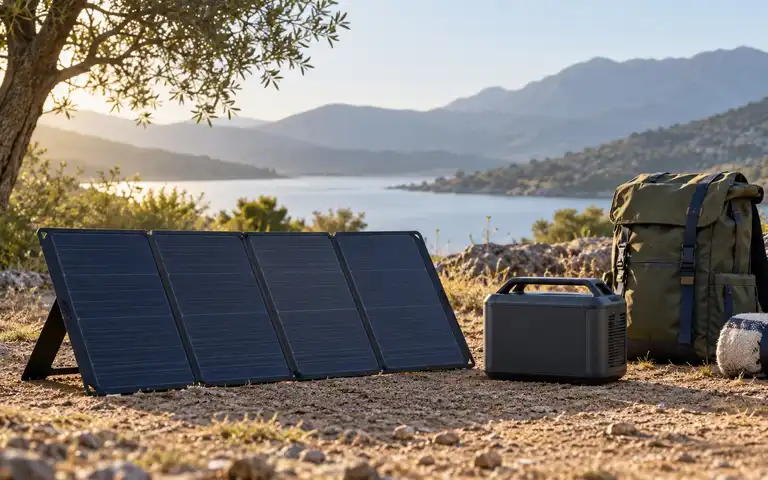
EcoFlow DELTA Pro
- Continuous AC output
- 3,600 W
Why it fits Delivers 3,600W continuous output (7,200W surge) with 30-amp transfer switch compatibility, providing immediate whole-home circuit backup without complex EV bidirectional vehicle charger hardware.
Key trade-off A single US DELTA Pro does not provide 240 V output. Two DELTA Pro units and a compatible separately sold Double Voltage Hub or Smart Home Panel are required; home-panel connections require qualified electrical work.
Specifications & research
30A 120V/240V Transfer switch compatible home backup battery. Source records checked on 2026-11-03. Manufacturer research, not hands-on testing.
- Nominal capacity
- 3,600 Wh · Source checked 2026-11-03
- Continuous AC output
- 3,600 W · Source checked 2026-11-03
- Base-unit weight
- 99 lb · Source checked 2026-11-03
Manufacturer documentation. Confirm the exact model, connections, and load requirements before buying.
Why EV 240V outlets trip standard transfer switches: the bonded-neutral GFCI trap
The single most common failure when connecting an EV’s onboard 240V / 30A outlet (such as a NEMA L14-30R receptacle in the truck bed) to a house panel is a neutral-ground loop.
In a standard North American residential main electrical panel, the neutral bus bar and the grounding bus bar are physically bonded together (NEC Article 250). Meanwhile, inside almost every electric vehicle equipped with onboard AC outlets, the vehicle’s inverter bonds its internal neutral conductor to the vehicle’s metal chassis ground and monitors the output through a sensitive Ground-Fault Circuit Interrupter (GFCI).
Because electric vehicles with 240V outlets bond neutral to chassis ground behind a GFCI sensor, a manual home transfer switch must switch the neutral conductor (3-pole) so neutral return current cannot split onto the ground wire.
- What happens on a standard 2-pole interlock or solid-neutral transfer switch: Only the two hot legs (
L1andL2) are switched; the neutral stays permanently tied to the house main panel. When you plug in the EV, the house neutral-ground bond and the EV neutral-ground bond form a parallel loop. Roughly half of the return current travels back to the truck on the green/bare equipment grounding wire instead of the white neutral wire. The EV’s GFCI sensor sees an imbalance exceeding5–20 mAbetween hot and neutral and trips off in less than a second. - How a 3-pole switched-neutral transfer switch solves it: A switched-neutral transfer switch (classified as a separately derived system under
NEC 250.30and702.7) physically disconnectsL1,L2, and the neutral conductor from the main panel simultaneously when switched to backup mode. That leaves only a single neutral-ground bond (inside the EV), so 100% of the return current stays on the neutral wire and the EV’s GFCI remains stable.
Four transfer architectures for EV home backup compared
| Transfer Architecture | Compatible EV Export Type | Continuous Power Capacity | Neutral & Grid Isolation Method | Typical Installed Scope & Tradeoffs |
|---|---|---|---|---|
| 1. Manual 3-Pole Switched-Neutral Transfer Subpanel (e.g., Reliance X-Series / Generac HomeLink switched-neutral class) | Onboard 240V / 30A EV outlet (NEMA L14-30R) via inlet box | 7.2 kW (30A @ 240V) across 6 to 10 selected circuits | Switches L1, L2, and Neutral simultaneously to prevent EV GFCI trips | Most reliable manual path for 240V EV outlets. Requires running a 30A cord outside; covers selected essential circuits only. |
| 2. Utility Meter-Collar Transfer Device (e.g., GenerLink 30A/40A collar where approved) | Approved 240V EV outlets (e.g., Ford Pro Power Onboard 7.2kW/9.6kW) | 7.2 kW – 9.6 kW (30A–40A @ 240V) to the main panel | Plugs between utility meter and socket; isolates utility legs and neutral automatically when cord is energized | Fast installation with no subpanel rewiring, but strictly requires electric utility approval and manual breaker management at the main panel. |
| 3. Automatic V2H Microgrid Interconnect Device (MID) (e.g., Ford HIS, GM Energy V2H Hub, Powershare Gateway) | Full Bidirectional DC or AC V2H Wallbox (CCS1 / NACS) | 9.6 kW – 19.2 kW (40A–80A @ 240V) whole-home or backed-up panel | Motorized UL 1741 / UL 9741 utility disconnect contactor + neutral-forming transformer/relay | Hands-free automatic failover, solar integration, and highest output; highest hardware and permitting cost. |
| 4. Standard 2-Pole Main Breaker Interlock Plate | Unbonded portable gas generators only (generally incompatible with GFCI-protected EVs) | Up to generator rating (30A or 50A) | Mechanical sliding plate blocks main and backfeed breakers; does not switch neutral | Avoid for bonded-neutral EV outlets—causes immediate EV ground-fault trips; never modify or unbond vehicle wiring. |
Worked calculation: sizing circuits for a 7.2 kW manual switch vs. a 9.6 kW automatic V2H gateway
Suppose you are deciding between connecting your electric truck’s 7.2 kW (240V / 30A) bed outlet to a manual switched-neutral transfer switch versus installing a 9.6 kW (240V / 40A) automatic V2H bidirectional charger and gateway.
Step 1: Audit Simultaneous Running Watts and Motor Surge
List the essential circuits your household needs during a winter storm outage:
- Kitchen Refrigerator (120V):
150 Wrunning /600 Wcompressor startup surge - Gas Furnace Blower & Ignition (120V):
600 Wrunning /1,100 Wblower startup surge - Deep Submersible Well Pump (240V, 3/4 HP):
1,500 Wrunning /3,600 Wlocked-rotor startup surge - Basement Sump Pump (120V, 1/3 HP):
800 Wrunning /1,600 Wstartup surge - Home Router, ONT & LED Lighting (120V):
120 Wrunning /120 Wsurge - Microwave or Induction Hotplate (120V):
1,400 Wrunning /1,400 Wsurge
Step 2: Check Continuous and Peak Headroom on Each Switch
- Baseline Simultaneous Running Load (all six active at once):
150 W + 600 W + 1,500 W + 800 W + 120 W + 1,400 W = 4,570 W (4.57 kW) - Worst-Case Coincident Surge (well pump kicks on while all other loads run):
4,570 W running + (3,600 W well pump surge - 1,500 W running) = 4,570 W + 2,100 W = 6,670 W (6.67 kW) - Comparing Against the 7.2 kW Manual Transfer Switch (
30A @ 240V):6,670 W ÷ 7,200 W = 92.6%of maximum continuous rating (27.8 Aper leg if balanced).- While
6.67 kWfits just inside7.2 kW, any leg imbalance on 120V circuits (each leg is capped at3,600 W / 30A) will trip the truck’s breaker if the1,400 Wmicrowave,800 Wsump pump, and600 Wfurnace blower all land on Leg A while the well pump starts. You must balance 120V circuits evenly acrossL1andL2and avoid running the microwave when pumps cycle.
- Comparing Against the 9.6 kW Automatic V2H Gateway (
40A @ 240V):6,670 W ÷ 9,600 W = 69.5%of rated capacity (4,800 W / 40Aavailable per 120V leg), leaving2,930 Wof clean headroom for unbalanced 120V loads or a heat-pump soft-start compressor.
Replace these illustrative wattages with the nameplate ratings on your own appliances and pumps.
Smart electrical panels and dynamic load shedding
When a 9.6 kW or 11.5 kW V2H gateway backs up a whole 200A main panel instead of a small 8-circuit subpanel, you need a way to keep high-draw 240V appliances—such as a 5,400 W clothes dryer, 4,500 W electric water heater, or 4-ton central A/C—from overloading the EV inverter during an outage.
As we cover in detail in our smart electrical panels and load-shedding guide, pairing a V2H gateway with motorized load-control relays or a smart breaker panel allows the house to automatically turn off non-essential 240V circuits the instant utility power fails, keeping total demand safely inside your EV inverter’s continuous limit.
Electrician scoping checklist for EV transfer switches
Print or save this checklist for your licensed electrical contractor’s site visit:
- Verify Vehicle Neutral Configuration in the Manual: Check whether your EV’s onboard 240V outlet is a bonded-neutral, GFCI-protected source, and show the manual specification page to the electrician.
- Specify a 3-Pole Switched-Neutral Transfer Switch for 240V Onboard Outlets: If using an inlet box with an EV’s 240V/30A receptacle, confirm that the transfer switch physically switches
L1,L2, andNeutralso no parallel ground return path exists. - Confirm Utility Acceptance Before Ordering a Meter Collar: If considering a meter-mounted device such as a GenerLink collar, call your electric utility first to verify whether meter collars are approved in your service territory.
- Balance 120V Critical Loads Across Both Phases (
L1andL2): Ask the electrician to map high-draw 120V circuits (furnace blower, sump pump, refrigerator, kitchen outlets) onto opposite phases so a single3,600 W(30A) leg is not overloaded. - Verify Permit, Inspection, and Interconnection Scope: Confirm in the written quote that the contractor will pull the municipal electrical permit, schedule the inspection, and handle any required utility notification.
- Perform a Live Load-Transfer Commissioning Test: Before signing off on the installation, unplug utility power (via the main disconnect), connect the EV, and verify that the transfer switch carries your refrigerator, furnace blower, and pumps without tripping the vehicle’s GFCI.
Frequently asked questions
Do I need a transfer switch for a bidirectional EV charger?
Yes. National and local electrical codes require a certified transfer switch or Microgrid Interconnect Device (MID) to physically isolate your home wiring from the utility grid before any backup power source—whether a bidirectional EV charger or an onboard 240V vehicle outlet—energizes house circuits. This isolation protects utility lineworkers from lethal backfed voltage and prevents your EV inverter from being destroyed when grid power returns.
What is the difference between a manual and automatic transfer switch for V2H?
A manual transfer switch (used with 240V onboard EV outlets) requires you to plug a heavy-duty 30-amp cord into the vehicle and manually flip breakers at a transfer subpanel to power selected circuits. An automatic transfer switch or Microgrid Interconnect Device (used with full V2H bidirectional wallboxes) detects a grid blackout in milliseconds, mechanically isolates the utility line, and powers your home automatically whenever the EV is plugged into its garage charger.