In this guideJump to a section
- Confirm what used or refurbished means before making an offer
- Match the exact serial number and check active recall registries
- Worked math: calculating battery degradation, inverter tare loss, and bench runtime
- Secondhand power station procurement and seller terms decision matrix
- Pre-purchase evidence record
A seller listing calls a portable power station “like new,” displays a lit LCD reading 100%, and claims it was “only used during two camping trips.” That screen reading does not reflect lithium battery state-of-health (SoH), internal cell resistance, or whether an active Consumer Product Safety Commission (CPSC) thermal-runaway recall applies to its specific manufacturing batch. Portable power stations combine dense lithium-ion or lithium iron phosphate (LiFePO4) battery cells, a high-voltage bidirectional inverter, and complex battery management system (BMS) logic into a sealed chassis. Because lithium cells degrade invisibly from calendar aging, heat exposure, and deep discharge cycles, judging a unit by cosmetic condition alone risks buying an expensive fire hazard.
Confirm what used or refurbished means before making an offer
The secondhand power station market spans three distinct categories, each carrying different financial and physical safety risks:
- Manufacturer Factory Refurbished: The original brand (such as EcoFlow, Bluetti, Jackery, or Anker) or its certified warranty service partner inspected the unit, flashed updated BMS firmware, load-tested internal cell modules, and repacked it with authentic factory AC and 12V DC charging cables. These units carry a transferable 1-year to 2-year factory warranty and a 30-day return policy.
- Third-Party or Seller Refurbished: A liquidation company, pawn shop, or marketplace refurbisher wiped the casing with isopropyl alcohol, plugged it into wall power until the display read 100%, and listed it online. No cell-level diagnostics occurred, internal thermal sensors were not tested, and any warranty is backed solely by an individual seller who may vanish next month.
- Private Peer-to-Peer Marketplace (As-Is): A private individual on Facebook Marketplace, Craigslist, or OfferUp sells an out-of-warranty station with no returns, no inspection records, and no legal recourse once cash changes hands.
Ask the seller directly for the original invoice or refurbishment certificate. If a seller advertises a station as “certified refurbished” but cannot produce a digital receipt from the manufacturer’s official eBay storefront, Amazon Renewed portal, or direct web store, categorize the unit as unverified private salvage.
Match the exact serial number and check active recall registries
Before arranging an in-person meetup or paying a deposit, request an unedited, high-resolution photograph of the specification rating plate located on the bottom or rear panel. This plate lists the regulatory model number, manufacturing date, and exact alphanumeric serial code.
Several major portable power station brands have experienced voluntary recalls through the U.S. Consumer Product Safety Commission (CPSC) due to internal battery cell defects, faulty inverter soldering, or thermal-runaway hazards. Cross-reference the model number and serial string against two primary databases:
- The CPSC Recall Portal: Run both the manufacturer brand and model string through the CPSC recalls and product safety database. Check whether notices mandate a factory repair, replacement of the AC charging adapter, or complete disposal.
- Manufacturer Safety Notices: Search the brand’s dedicated support page for service bulletins. Brands frequently issue silent firmware updates or voluntary serial recalls that predate formal federal notices.
If a seller claims that the unit was already serviced under the recall, ask for the manufacturer’s RMA return paperwork or service invoice showing the serial number and technician sign-off. Never take a seller’s verbal assurance that a fire-hazard recall was resolved.
Worked math: calculating battery degradation, inverter tare loss, and bench runtime
Never trust the percentage displayed on an idle power station screen. Lithium battery management systems measure terminal open-circuit voltage to estimate state of charge. A severely degraded battery pack with high internal resistance can read 100% when sitting idle, but collapse to 0% within minutes once a heavy load is applied.
1. Calculating true deliverable AC watt-hours
A power station’s rated capacity is the DC energy stored inside the raw battery pack. Converting that DC energy into 120V alternating current (AC) incurs two inescapable physics penalties: inverter tare loss (idle power consumed simply keeping the inverter active) and thermal conversion losses.
- Nominal nameplate capacity: 1,024 Watt-hours (Wh).
- Inverter conversion efficiency: Typically 85% on modern pure sine wave inverters (15% dissipated as internal heat).
- Fresh deliverable AC capacity: 1,024 Wh × 0.85 = 870.4 Watt-hours.
2. The 300-watt bench discharge load test
To measure true State of Health (SoH) during an evaluation window, connect a steady, non-cycling resistive load (such as a 300W halogen work lamp or bench resistive load) to the 120V AC outlet and start a digital stopwatch:
- Healthy factory baseline runtime (100% SoH): 870.4 Wh ÷ 300 Watts = 2.90 hours = 174 minutes.
- Degraded used unit runtime observation: Suppose a secondhand unit shuts down with a low-voltage cutoff error after 116 minutes: Delivered AC Energy = 300 Watts × (116 minutes ÷ 60 minutes) = 580 Watt-hours. Calculated State of Health (SoH) = 580 Wh ÷ 870.4 Wh = 66.6%.
When deliverable capacity drops below 70% of factory specifications, the lithium cells have reached the end of their design life. Internal cell resistance causes severe voltage sag under motor-starting surges, rendering the station useless for critical backup loads like refrigerators or medical equipment.
3. Battery chemistry degradation physics: LiFePO4 vs. NMC
The internal chemistry dictates how rapidly the pack degrades over time:
- Lithium Iron Phosphate (LiFePO4 / LFP): Delivers 3,000 to 3,500 full discharge cycles before reaching 80% capacity. Calendar aging is minimal; stored at 68°F (20°C), capacity drops only 1.5% to 2.0% per year.
- Nickel Manganese Cobalt (NMC): Delivers only 500 to 800 cycles to 80% capacity. More critically, NMC chemistry suffers severe thermal calendar aging. Storing an NMC power station at 100% state of charge in a hot garage or attic at 95°F (35°C) degrades 10% to 15% of total capacity every 12 months without cycling the unit once.
Secondhand power station procurement and seller terms decision matrix
The table below contrasts secondhand procurement channels by risk profile, inspection requirements, and operating limitations.
| Procurement Channel | Typical Warranty & Returns | Required Physical Verification | Who Should Skip It | Fails When / Operating Limit |
|---|---|---|---|---|
| Manufacturer Certified Refurbished (Official Store) | 1 to 2-year factory warranty; 30-day no-hassle return window | Verify factory refurbishment certificate and sealed OEM packaging | Skip if seeking maximum rock-bottom pricing on obsolete models | Fails when: Third-party refurbisher uses brand name without factory authorization. |
| Authorized Open-Box Retailer (B&H, Best Buy Outlet) | 90-day return policy; balance of original factory warranty | Inspect cosmetic scratches and verify all OEM charging cables present | Skip if remote shipping costs make return freight prohibitive | Fails when: Return policy excludes battery degradation below 80% SoH. |
| Peer-to-Peer Marketplace (Local Cash / Meetup) | Zero warranty; strictly as-is final sale with no buyer recourse | Conduct mandatory 300W resistive bench load test before handing over cash | Skip if you lack testing equipment or cannot test for 45+ minutes | Fails when: Seller refuses live bench test or insists on parking lot transfer without power. |
| Liquidation / Return Pallet As-Is | No warranty; final sale; high probability of defective internal BMS | Requires multimeter testing and internal disassembly by certified technician | Skip unless purchasing strictly for parts harvesting or repair | Fails when: BMS locks out charging due to permanently bricked 0V lithium cells. |
Pre-purchase evidence record
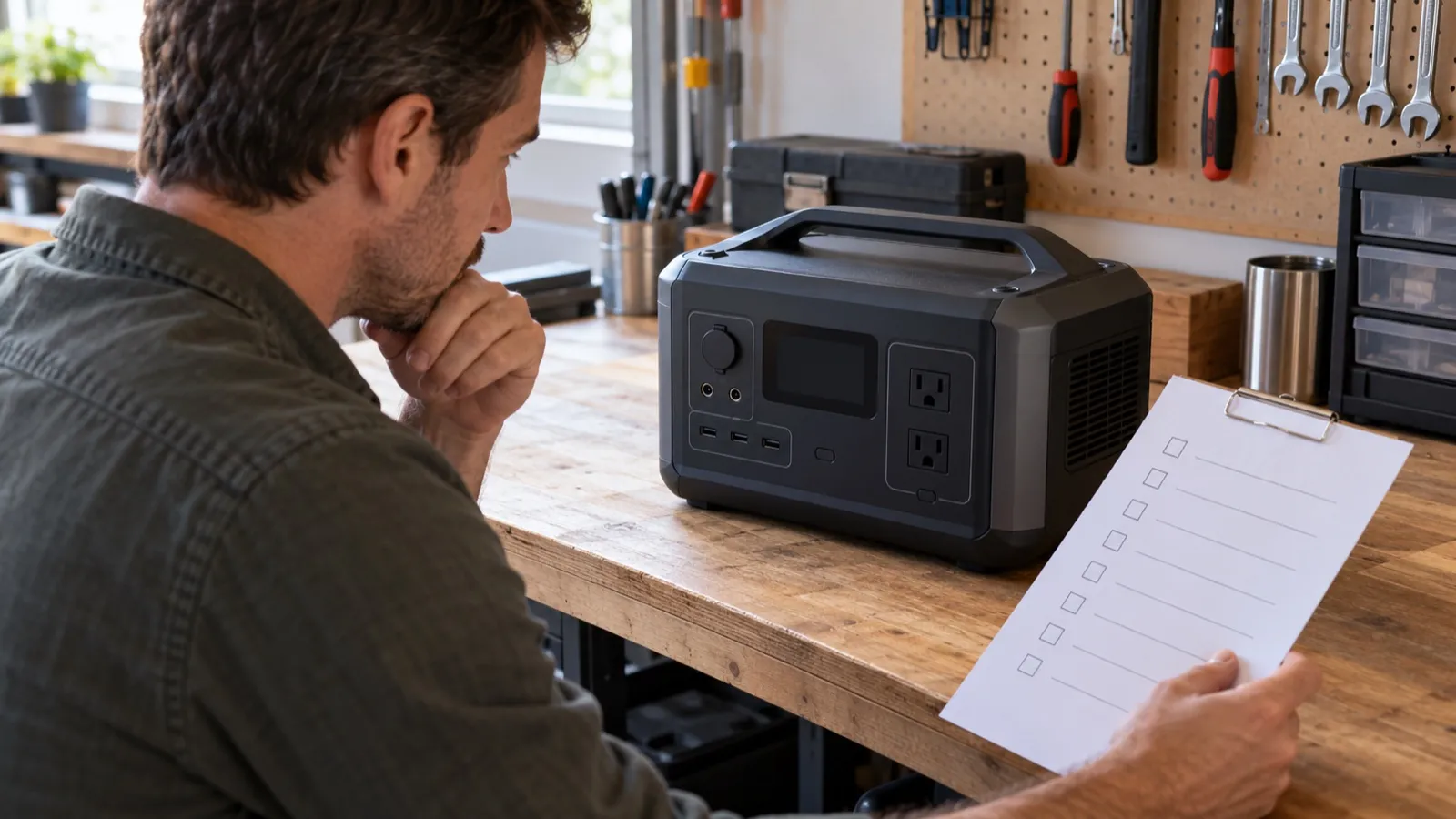
Before committing funds to any secondhand portable power station, work through this physical inspection checklist. Complete every check on-site or verify clear digital proof before finalizing payment.
- Rating plate photograph verified: Model number, revision code, and serial number are clearly legible and unmarred.
- CPSC recall check clear: Database search confirms zero unresolved safety or thermal-runaway recalls for this exact batch.
- Casing geometry inspection: Plastic shell is completely flat with no bulging, seam separation, or warped corners (signs of cell swelling).
- Ventilation port check: Cooling grills and fan blades are free of thick grime, pet hair, insect nests, or metallic dust.
- Sensory sniff test: Sniff directly at the exhaust fan grill; walk away immediately if you smell sweet chemical solvents, fishy odors, or charred wiring.
- Input port integrity: High-amperage DC charging ports (XT60, Anderson Powerpole, or barrel jacks) show no scorched pins, cracking, or play.
- AC outlet tension test: Plugs seat firmly into the 120V receptacles without slipping out under their own cord weight.
- Firmware version confirmed: If the unit connects to a companion smartphone app, pair the device to confirm the latest BMS firmware is installed.
- Live discharge test conducted: Unit powers a 300W to 500W continuous resistive load for at least 30 minutes without error codes or thermal tripping.
- OEM charging accessories included: Original AC charging brick/cord and 12V automotive charging cable are present and undamaged.
Safe transport and home commissioning protocol
Transporting a used lithium battery requires deliberate care. Secure the unit upright in your vehicle’s cargo area, surrounded by non-combustible surfaces. Never transport a power station inside a hot passenger cabin left in direct summer sunlight, and avoid placing heavy cargo on top of the chassis.
When you bring a secondhand station home, quarantine it during its initial full recharge. Place the unit on a bare concrete garage floor or workshop bench, at least 10 feet away from combustible materials, drywall, and fuel cans. Plug the unit into a GFCI-protected wall outlet and monitor casing temperature every 30 minutes. The exterior plastic should feel warm to the touch (100°F to 110°F / 38°C to 43°C during rapid charging), but never painfully hot. If the casing exceeds 130°F (54°C), emits a clicking relay sound, or vents odors, unplug the AC power cord immediately and contact the manufacturer.
Establish a documented baseline runtime on day one. Charge the pack to 100%, plug in your primary emergency appliance (such as a 150-watt full-size refrigerator or 60-watt medical device), and log the elapsed hours until low-voltage cutoff. Record this baseline runtime, the ambient room temperature, and the date directly on a label affixed to the unit’s underside. Repeating this discharge test annually provides observable evidence of battery health, ensuring your emergency backup power performs as expected when the grid fails.