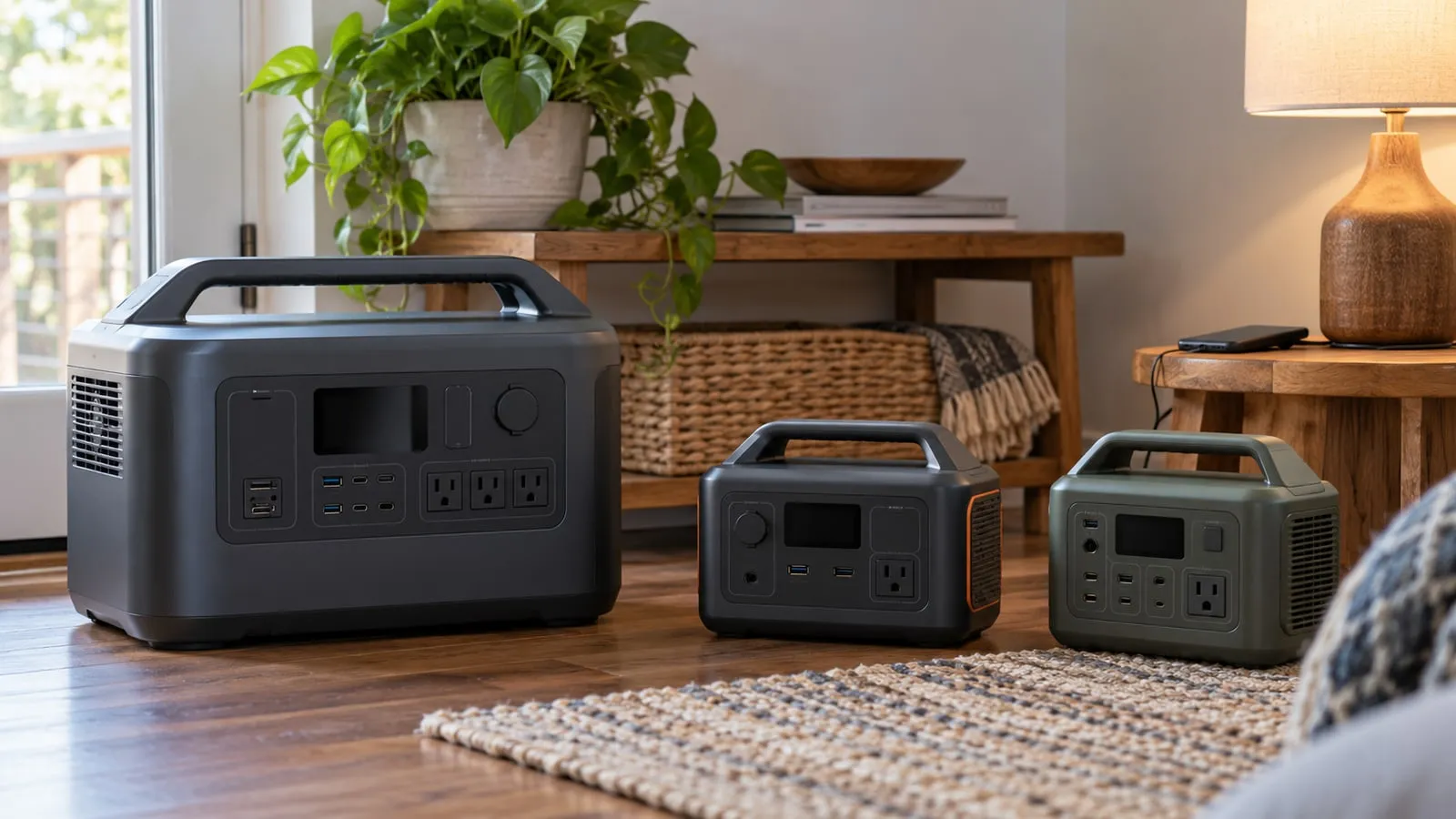
Deciding between a single 2,000-watt-hour portable power station and two 1,000-watt-hour units comes down to inverter continuous output limits, physical lifting thresholds, and idle tare loss penalties—not just total stored energy. While both configurations store roughly 2 kilowatt-hours of lithium battery capacity, splitting that capacity across two independent chassis fundamentally alters how conversion inefficiencies drain your reserves, whether you can run high-draw motor loads, and what happens when an electronic BMS component fails during an extended grid blackout.
Inverter tare loss and continuous output physics: Wh vs. W
Energy capacity in Watt-hours (Wh) defines how long a battery can deliver power, while power in Watts (W) dictates the maximum instantaneous electrical demand the inverter can supply without tripping its internal circuit protection.
Every alternating current (AC) pure sine wave inverter consumes parasitic electrical power simply keeping its internal direct-current to alternating-current switching MOSFETs, cooling fans, and microprocessors energized. This continuous baseline drain is known as inverter tare loss (or idle draw):
- A typical 2,200W inverter (in a 2,048 Wh station) consumes 15 to 20 Watts continuously whenever its AC outlets are toggled on, even with nothing plugged into the receptacles. Over 24 hours, this tare loss consumes 360 to 480 Watt-hours (18% to 23% of total battery capacity) purely as overhead.
- Two separate 1,000W inverters (in two 1,024 Wh stations) consume 10 to 14 Watts each, totaling 20 to 28 Watts combined idle draw. If both stations leave their AC ports active overnight, tare losses consume up to 672 Watt-hours across the two units.
However, two smaller stations give you the tactical ability to turn one inverter completely off. If you are sleeping and only powering a 30W medical CPAP machine in the bedroom, leaving one station active while the second station sits powered down reduces idle tare loss to just 12 Watts, preserving the second battery at 100% state of charge for morning refrigeration.
Worked math: inverter efficiency, tare loss penalties, and runtime divergence
To illustrate how these engineering trade-offs impact actual outage runtime, compare how both architectures handle real household emergency loads.
1. The low-draw overnight medical and communication load
Consider a household running a 35W CPAP machine and a 15W Wi-Fi router for 8 hours overnight (total active load = 50 Watts continuous; 400 Watt-hours net theoretical requirement):
- Scenario A (One 2,048 Wh Station, 2,200W Inverter):
- Active draw: 50 Watts.
- Inverter tare loss: 16 Watts.
- Total continuous draw from battery: 66 Watts.
- Total energy consumed over 8 hours: 66 W × 8 hrs ÷ 0.88 conversion efficiency = 600 Watt-hours.
- Battery capacity remaining in morning: 2,048 Wh - 600 Wh = 1,448 Wh (70.7% remaining).
- Scenario B1 (Two 1,024 Wh Stations, both AC inverters left active):
- Unit 1 powers CPAP (35W + 12W tare = 47W draw). Over 8 hrs: 47 W × 8 ÷ 0.88 = 427 Wh consumed.
- Unit 2 powers Wi-Fi (15W + 12W tare = 27W draw). Over 8 hrs: 27 W × 8 ÷ 0.88 = 245 Wh consumed.
- Total energy consumed across both: 427 Wh + 245 Wh = 672 Watt-hours (72 Wh higher penalty due to dual tare loss).
- Scenario B2 (Two 1,024 Wh Stations, tactical single-inverter deployment):
- Both CPAP and router are connected to Unit 1 located in the bedroom via an extension cord. Unit 2’s inverter is toggled completely OFF.
- Unit 1 total draw: 50W active + 12W tare = 62 Watts. Energy consumed: 62 W × 8 ÷ 0.88 = 563 Watt-hours.
- Morning status: Unit 1 has 461 Wh remaining (45%); Unit 2 sits in the kitchen completely untouched at 1,024 Wh (100% full), ready to power the morning refrigerator and coffee routine.
2. High-wattage starting load limitations
The decisive operational limit of smaller power stations is instantaneous inverter capacity:
- A full-size 22 cu. ft. modern refrigerator consumes only 120W to 180W while running, but its induction compressor draws an inrush surge of 1,200W to 1,600W for 800 milliseconds upon startup.
- A 1,000W power station with a 1,500W peak surge rating operates right at its electronic trip boundary. If the refrigerator attempts to start while a phone or lamp is also plugged into the station, the inverter enters overload protection (E03 fault) and cuts AC power.
- The 2,048 Wh station features a 2,200W continuous / 4,400W surge inverter, absorbing compressor startup surges effortlessly while simultaneously powering coffee makers or countertop microwaves.
You cannot physically combine the AC outputs of two independent stations using a Y-cable. Because the two internal inverters oscillate independently without frequency synchronization, tying their AC plugs together causes an immediate phase-short explosion that permanently destroys both inverters. Parallel coupling requires a manufacturer-engineered communication link and specialized parallel box (such as Bluetti or EcoFlow proprietary kits).
One large vs. two smaller power stations decision matrix
The decision matrix below contrasts system architectures across capacity, output, physical handling, and failure modes.
| System Architecture | Inverter Output & Surge Headroom | Carrying Weight & Ergonomics | Recharging Flexibility | Who Should Skip It | Fails When / Operating Limit |
|---|---|---|---|---|---|
| One Large Station (2,000–2,500 Wh) | 2,200W–3,000W continuous; 4,400W–6,000W surge | 48 to 65 lbs (22–29 kg); requires built-in wheels or two people | Single AC cord or single high-voltage solar string (up to 500–1,000W MPPT) | Skip if you live in a multi-story home and must haul backup power up stairs | Fails when: Inverter motherboard or BMS fails; entire home backup capability is lost instantly. |
| Two Small Stations (2× 1,000 Wh) | 1,000W–1,200W per unit (cannot be combined on 1 circuit) | 22 to 28 lbs (10–13 kg) per unit; easily carried with one hand | Can recharge one unit outdoors via solar while second powers indoor fridge | Skip if you must power a 1,500W space heater, microwave, or well pump | Fails when: High-surge motor load exceeds the 1,000W individual unit inverter limit. |
| Modular Base + Add-On Battery (1,000 Wh + 1,000 Wh) | 1,500W–1,800W continuous through base station | Base unit 28 lbs; expansion pack 20 lbs (carried separately) | Single charging port charges both packs simultaneously via DC bus | Skip if you need to run simultaneous loads in two physically separate rooms | Fails when: The base station inverter fails; the passive expansion pack cannot output AC power alone. |
| Two Micro Stations (2× 300–500 Wh) | 300W–600W per unit; modified or basic pure sine | 8 to 14 lbs (3.6–6.3 kg); backpack portable | Highly versatile 60W USB-C and 100W foldable solar panel charging | Skip if home emergency plan includes food preservation or medical chilling | Fails when: Connected appliance draws continuous current exceeding 500 watts. |
Load allocation record
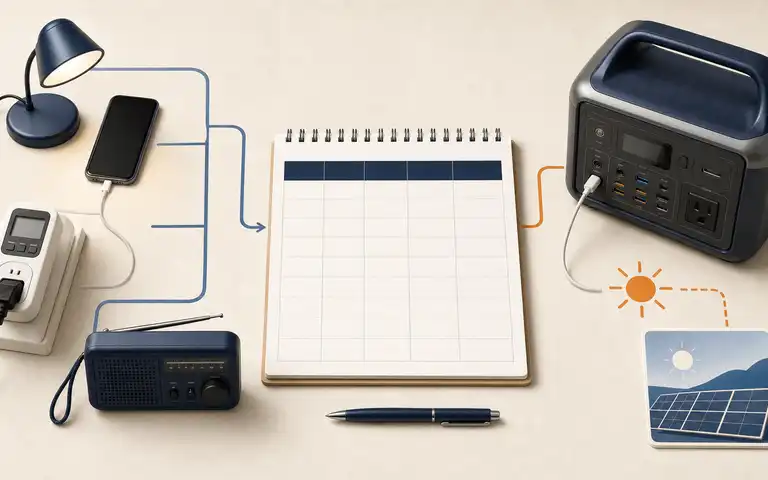
Before selecting your equipment architecture, build a household load allocation map. Partitioning your essential emergency appliances between separate physical locations ensures you do not purchase a station that fails to meet real-world operating demands.
1. Documenting room allocations and electrical profiles
Record each appliance’s running watts and motor-starting surge requirements:
- Zone 1: Food Preservation (Kitchen): Full-size refrigerator (150W running, 1,500W surge) plus compact freezer (100W running, 1,000W surge). Minimum inverter threshold: 1,800W surge rating.
- Zone 2: Medical and Climate (Master Bedroom): CPAP machine (35W running, zero surge) or portable oxygen concentrator (150W running) plus 12V DC heating blanket (45W). Minimum storage threshold: 600 Watt-hours for 8 hours of uninterrupted sleep.
- Zone 3: Communications and Lighting (Living Area): Fiber ONT box and Wi-Fi router (25W continuous) plus two 9W LED lamps and phone chargers. Continuous draw: 50 Watts.
If your primary emergency concern is powering both Zone 1 (Kitchen) and Zone 2 (Bedroom) simultaneously, running long extension cords down hallways creates severe tripping and door-pinch hazards. Two independent 1,024 Wh stations allow you to place one unit directly beside the refrigerator and the second unit directly beside the bedroom nightstand.
2. Ergonomics and OSHA lifting considerations
The physical weight of lithium batteries is frequently overlooked until an outage forces a homeowner to move equipment in the dark. A standard 2,048 Wh LiFePO4 power station weighs between 50 and 60 pounds (23 to 27 kg). Under Occupational Safety and Health Administration (OSHA) single-person manual lifting recommendations, lifting loads over 50 pounds poses a high risk of musculoskeletal injury.
For older adults, individuals with chronic back issues, or residents in multi-level townhomes where the main living floor is upstairs from the garage, moving a 55-pound power station up a flight of stairs during a power outage is unsafe. In contrast, two 1,024 Wh stations weigh approximately 24 to 27 pounds each—comparable to carrying a standard gallon-and-a-half jug of water in each hand.
3. Redundancy and single-point failure mitigation
Inverters and battery management systems are complex solid-state electronics. If an internal fuse blows, a cooling fan bearing seizes, or an overvoltage spike trips the BMS into permanent lock mode, a single large power station becomes entirely useless. You lose your ability to preserve food, power medical equipment, and charge communications devices simultaneously.
Operating two smaller stations provides true operational redundancy. If Unit 1 suffers a hardware defect, Unit 2 remains fully functional. You can prioritize medical devices overnight, then move Unit 2 to the kitchen during the day to run the refrigerator for two-hour chilling cycles. This redundancy provides superior physical resilience during prolonged civil emergencies.