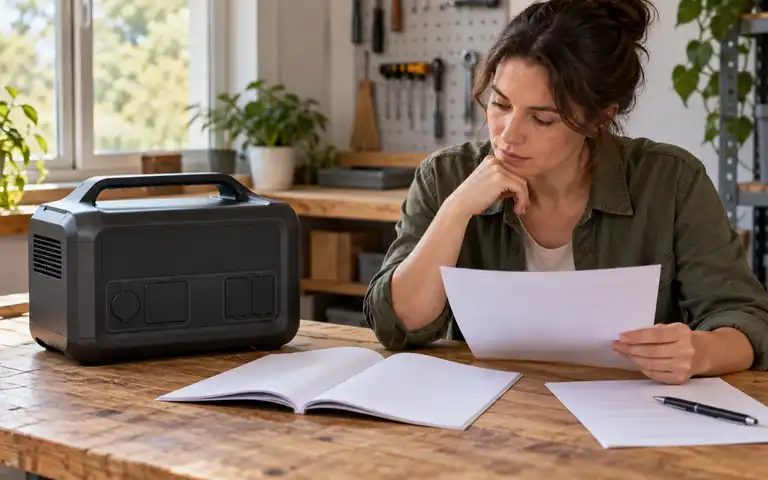
Compare home-battery proposals using the same outage scenario and site assumptions. A larger stated energy capacity does not necessarily mean more usable energy at the loads that matter, and it does not establish whether the system can start or support them. Ask each qualified provider to state the system configuration and limits in writing.
Start with one outage scenario
List the loads that must be covered, which may be simultaneous, how long they may run, and what can be shed first. Record their measured energy use and starting demand where known. Keep medical equipment requirements with the equipment provider and care team; this comparison cannot establish life-safety suitability.
The battery runtime guide separates watts from watt-hours for portable equipment. This page is about permanent home proposals, where the installer and local authority determine the complete-system design and connection.
Compare the proposal, not just the battery label
| Comparison field | Ask both providers to state | Proposal A | Proposal B |
|---|---|---|---|
| Exact system | Battery, inverter, controls, transfer equipment, required accessories, and manuals | ||
| Energy and power | Usable kWh, continuous kW, starting/overload limits, reserve, and any temperature limits as documented | ||
| Backed-up loads | Exact circuits or loads, expected simultaneous operation, and load-shedding assumptions | ||
| Outage behavior | What transfers, whether operation is automatic/manual, and what requires the household to act | ||
| Recharge | Grid behavior, included solar, supported generator input, and what is excluded | ||
| Installation scope | Electrical upgrades, mounting/location work, equipment, permits, inspections, and utility coordination | ||
| Commissioning | Demonstration, acceptance criteria, test record, shutdown and emergency information, household training | ||
| Ownership | Equipment, labor, throughput or cycle terms if stated, exclusions, service contact, and recurring costs | ||
| Missing assumptions | Unverified site conditions, required add-ons, and change-order process |
A proposal should say whether a capacity figure is nominal or usable and under what operating conditions it applies. Record the source document and page for technical specifications. The precise terms in the manufacturer’s warranty and the signed installation contract control; a sales summary is not a substitute.
Same-scenario battery brief
Use the same document for each provider:
- Outage scenario and duration to plan around:
- Critical loads and measured energy use:
- Loads that may run simultaneously and known starting demand:
- First loads to shed:
- Existing solar, generator, utility, and electrical information known:
- Site conditions the provider must inspect:
- Questions for the local authority or utility:
- Service, commissioning, and household-training expectations:
Do not open an electrical panel or move equipment to collect data. Mark uncertain entries “unknown” and ask the provider what inspection is required.
Comparing the physical installed system boundary versus merely reading the battery nameplate capacity.
Worked example: two incomplete proposals
Imagine two fictional proposals for the same household. Proposal A states a usable-energy value but does not identify the backed-up circuits or simultaneous output assumption. Proposal B names those circuits but does not say whether solar can recharge the battery when the grid is down or what commissioning proves. Neither comparison is complete. Ask each provider to fill its missing fields; do not treat the larger kWh label or a lower unexplained total as the winner. This example contains no actual product, capacity, price, or performance result.
DOE notes that grid-tied solar generally shuts down during an outage unless configured with the required inverter and storage. UL describes system-level evaluation and notes that code authority requirements can differ. Ask the provider to identify the exact listed equipment, installation instructions, local approval path, and written test record for the proposed design. This guide does not interpret a code or decide which battery a home should buy.
When evaluating these physical mechanisms and installation boundaries, homeowners must verify the concrete safety thresholds and failure-mode steps that apply when the grid fails. For instance, the transfer switch must reliably disconnect the home from the grid to prevent backfeeding, a critical physical mechanism that ensures line worker safety. If the battery is depleted and the grid remains down, what is the exact physical failure-mode step? Does the system automatically wake up when solar production resumes, or does it require a manual black-start procedure? Understanding these concrete physical mechanisms is paramount. Primary-source safety thresholds, such as the maximum continuous kW output and the maximum starting surge, determine whether a well pump or air conditioner will stall or successfully start. If the starting demand exceeds the inverter’s physical capacity, the system will enter a failure mode, likely shedding the load or shutting down completely to protect the components.
You must also verify the physical location constraints and thermal safety thresholds. Batteries have specific operating temperature limits. If a proposal places the unit in an unconditioned garage that exceeds the manufacturer’s primary-source safety thresholds during summer, the battery management system’s physical mechanism will either throttle charging or shut down entirely, leaving the home without power when it might be needed most. Therefore, the proposal must account for these concrete physical realities, not just ideal scenarios. Ensure the provider explains the exact failure-mode steps if the battery overheats or if the grid outage outlasts the usable energy capacity. Finally, review the physical verification steps expected during commissioning.
- I have obtained the stated usable kWh and continuous kW output from both providers under identical temperature and site conditions.
- I have matched the exact list of backed-up circuits and verified the inverter can physically start the largest simultaneous load.
- I have documented the physical transfer mechanism and the exact failure-mode steps if the battery is fully depleted during an extended outage.
- I have confirmed the installation location meets the manufacturer’s primary-source thermal and environmental safety thresholds.
- I have established the required physical commissioning tests and written handover procedures that prove the system functions as proposed.