In a prolonged regional disaster, individuals managing celiac disease or severe non-celiac gluten sensitivity face a hidden supply-chain hazard: commercial disaster feeding programs and standard civilian survival kits rely heavily on wheat-based shelf-stable rations. Institutional relief kitchens routinely deploy wheat flour thickeners, hydrolyzed wheat protein, and barley malt extracts to formulate high-calorie emergency meals.
Surviving an evacuation or extended grid blackout requires understanding that “wheat-free” does not mean “gluten-free,” and that trace parts-per-million (ppm) cross-contact across multiple daily meals accumulates into toxic milligram quantities that destroy intestinal villi.
The 20 ppm threshold physics, cumulative gluten intake, and gut villous atrophy
Managing gluten-free emergency nutrition requires mastering the biochemical distinction between major allergen statutes and gluten-free labeling standards.
The biochemical architecture of gluten
Gluten is a composite storage protein composed of two primary fractions: alcohol-soluble prolamins and dilute-acid-soluble glutelins. The specific toxic prolamin peptides vary by botanical grain species:
- Wheat: Gliadin
- Barley: Hordein
- Rye: Secalin
- Triticale: A synthetic cross of wheat and rye containing both hybrid proteins
In genetically susceptible individuals carrying HLA-DQ2 or HLA-DQ8 haplotypes, exposure to these prolamin peptide chains stimulates intestinal tissue transglutaminase (tTG), triggering an autoimmune mucosal immune response. The resulting lymphocytic infiltration leads to blunting and flattening of microscopic small-bowel villi (villous atrophy), causing acute malabsorption, debilitating gastrointestinal distress, electrolyte wasting, and severe systemic inflammation.
The FDA 20 ppm legal threshold vs. the 10 mg clinical ceiling
Under 21 CFR 101.91, the FDA defines the voluntary label claim “gluten-free” (along with “no gluten,” “free of gluten,” and “without gluten”) to mean that the food inherently contains no gluten-containing grains, or has been processed to remove gluten, resulting in a presence below 20 parts per million (ppm). Mathematically:
20 ppm = 20 mg gluten per 1,000 g (1 kg) of finished food = 0.02 mg gluten per gram of food.
However, seminal clinical threshold trials (Fasano et al., Catassi et al.) establish that the daily ingestion limit for celiac patients is under 10 milligrams (mg) of gluten per day. Ingesting more than 10 mg per day consistently induces significant intestinal mucosal architecture breakdown.
The FALCPA labeling loophole: why “wheat-free” is insufficient
Under the Food Allergen Labeling and Consumer Protection Act (FALCPA), manufacturers must declare the presence of the nine major food allergens in plain language. Wheat is a major allergen, but barley and rye are not.
Consequently, a food label can truthfully state:
- “Contains: Soy, Milk” (with no wheat declared)
- Yet simultaneously list barley malt extract, malt vinegar, or rye flour in the secondary ingredient list.
A consumer checking only the bold “Contains” line will ingest concentrated hordein or secalin prolamins, triggering immediate autoimmune enteropathy. Every emergency package must be audited line-by-line through the complete ingredient panel.
Worked nutritional calculation: cumulative daily parts-per-million intake
During an emergency, an individual consumes a larger physical mass of preserved carbohydrates to meet elevated caloric requirements. Examining the mathematical relationship between food mass and parts-per-million purity reveals how easy it is to exceed the 10 mg safety ceiling.
Calculating cumulative gluten ingestion from 20 ppm foods
Suppose an adult requiring 2,200 kcal/day during an emergency shelter-in-place scenario relies on commercial processed “gluten-free” packaged staples (crackers, specialty granola, pre-packaged shelf-stable pasta, and meal pouches):
-
Total daily dry food intake: 500 grams (1.1 lbs) of manufactured specialty gluten-free foods.
-
Average trace gluten contamination: Assume the foods average 16 ppm (compliant with the FDA < 20 ppm regulation).
-
Gluten concentration in food: 16 mg gluten ÷ 1,000 g food = 0.016 mg gluten per gram.
-
Total daily gluten ingestion from food mass:
500 g food × 0.016 mg/g = 8.0 mg of gluten.
At 8.0 mg, the individual is already consuming 80% of their maximum daily biological safety threshold strictly from certified legal foods.
The impact of a minor cross-contact contamination event
Now introduce an emergency preparation compromise: a camp stove spatula previously used on a wheat-flour pancake transfers an invisible crumb of wheat flour weighing just 0.025 grams (25 mg) into the meal:
-
Regular white wheat flour contains approximately 12% gluten (120 mg gluten per gram of flour).
-
Gluten transferred by the 0.025 g crumb:
0.025 g flour × 120 mg gluten/g = 3.0 mg of pure gluten.
-
Total cumulative daily dose:
8.0 mg (from legal food) + 3.0 mg (from crumb) = 11.0 mg total gluten.
The individual has now breached the 10 mg clinical toxicity threshold. Within hours, acute enteropathy, dehydration from diarrhea, and abdominal cramping will incapacitate them during an active crisis. This mathematical reality proves that an emergency pantry must be grounded primarily in naturally gluten-free, single-ingredient whole staples (rice, dried beans, potatoes) rather than heavily processed specialty foods.
Gluten-free pantry staple decision matrix and failure boundaries
The matrix below contrasts common emergency staple categories by certification rigor, agricultural cross-contact risk, and practical field operating limits.
| Staple Category & Processing Type | Gluten Regulatory Status | Agricultural / Mill Cross-Contact Risk | Shelf Life at ≤ 70°F (21°C) | Who Should Skip It / Fails When |
|---|---|---|---|---|
| Polished White Rice (Long/Medium Grain) | Naturally gluten-free (prolamin is oryzenin, safe) | Near Zero when sourced from pure rice mills | 25–30 years in Mylar with O2 absorber | Skip if: Requiring instant preparation; raw rice requires 15–20 minutes simmering and 2 cups water per cup grain. |
| Certified Gluten-Free Purity Protocol Oats | Mandated < 20 ppm (often verified < 5–10 ppm) | Very Low (grown on dedicated fields, dedicated harvesters) | 1–2 years in factory bag; 10+ yrs in Mylar | Skip if: Individual reacts to avenin (up to 5% of celiac patients exhibit immune sensitivity to oat avenin peptides). |
| Standard Commodity Rolled Oats (Uncertified) | High Risk; unregulated agricultural commingling | Extreme (crop rotation with wheat, shared rail cars) | 1–2 years | Skip universally: Never stock standard grocery oats for celiac emergency reserves; wheat contamination frequently exceeds 100 ppm. |
| Canned Plain Legumes (Black Beans, Chickpeas) | Naturally gluten-free | Low (water, salt, and bean only; verify can label) | 2–5 years unopened | Skip if: Water-weight constrained during foot evacuation; heavy steel cans add significant transport mass. |
| Commercial Freeze-Dried GF Entrees (Pouch) | Third-party certified GF mark (GFCO, CSA) | Low to Moderate (shared facility risk requires strict audit) | 10–25 years hermetically sealed | Skip if: Cost-sensitive; costs 4× to 6× more per calorie than bulk white rice and certified dry beans. |
| Commercial Cornmeal & Masa Harina | Naturally gluten-free grain | High unless certified (shared stone grinding mills) | 1 year ambient (oil in germ oxidizes) | Skip if: Uncertified; standard commercial corn mills grind wheat flour on identical equipment without wet wash-downs. |
For structuring whole-family caloric balance across extended outages, integrate your gluten-free staples with the comprehensive meal grids in our two-week emergency menu plan.
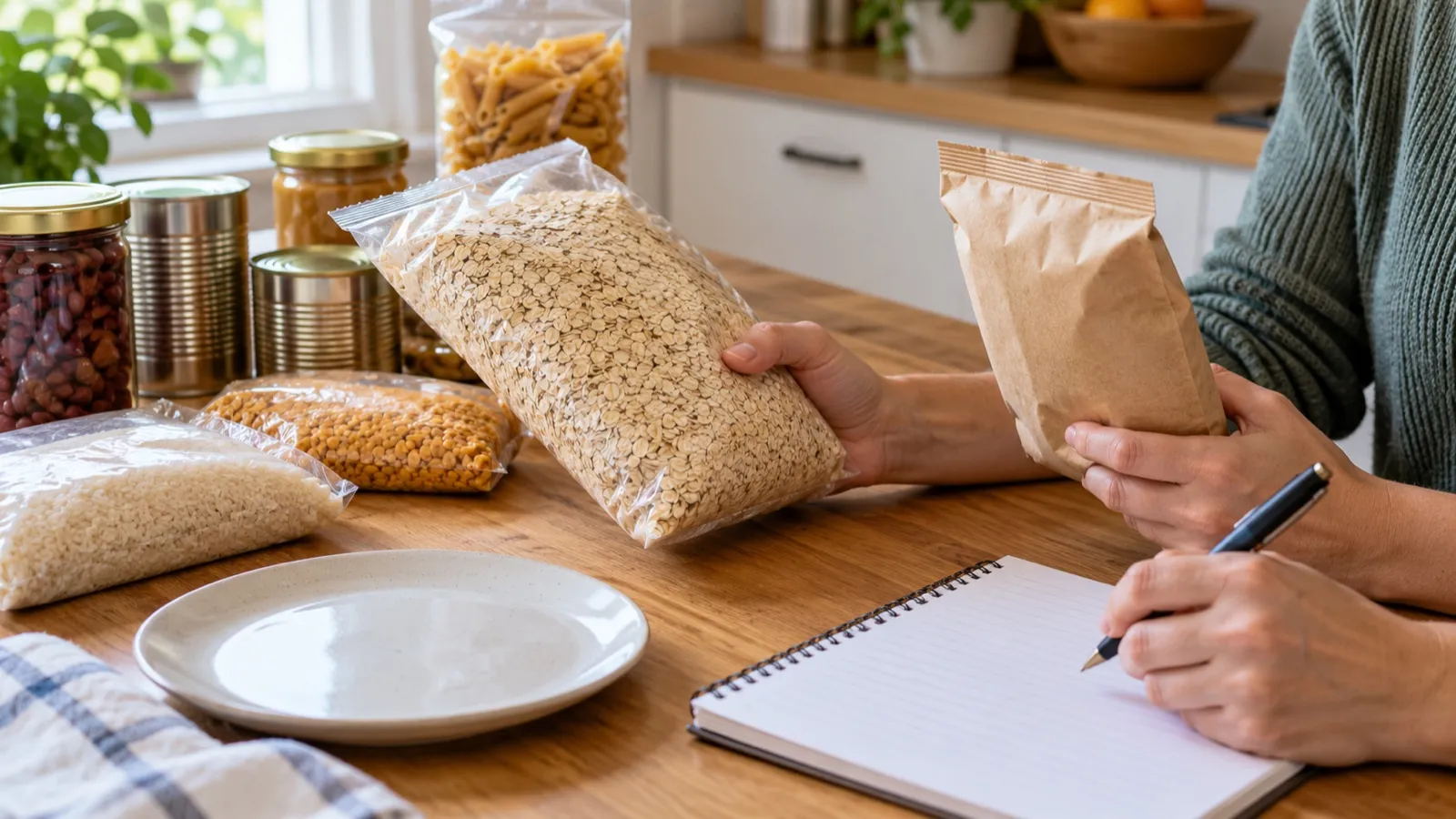
Check each actual package
When auditing emergency rations for a household member managing celiac disease or gluten sensitivity, apply this four-step package verification and cross-contact prevention protocol:
-
Conduct an exhaustive four-tier label inspection:
- Tier 1: Look for third-party certification logos. Prioritize products certified by the Gluten-Free Certification Organization (GFCO, requiring ≤ 10 ppm) or the Celiac Support Association (CSA, requiring ≤ 5 ppm).
- Tier 2: Verify FDA voluntary gluten-free wording. If not third-party certified, confirm the package explicitly states “Gluten-Free.” This legally binds the manufacturer to the 21 CFR 101.91 standard (< 20 ppm).
- Tier 3: Audit the comprehensive ingredient panel. Scan for hidden gluten sources exempt from major allergen labeling: barley malt, malt extract, malt flavoring, malt vinegar, brewer’s yeast, hydrolyzed wheat protein, triticale, farro, spelt, and durum.
- Tier 4: Review voluntary advisory warnings. Note statements such as “Manufactured in a facility that also processes wheat.” While the FDA does not regulate these precautionary phrases, highly sensitive individuals should avoid products bearing shared-line wheat warnings.
-
Establish isolated storage zones and indelible color coding:
- Never store certified gluten-free goods on shelves beneath standard wheat flour or baking mixes. Paper flour sacks release airborne dust that settles on underlying containers. Store gluten-free supplies on top shelves or inside dedicated, airtight plastic totes.
- Wrap bright red vinyl tape around all gluten-free emergency containers, or mark them with a permanent red marker (“GF ONLY”). Ensure every family member understands that red-tagged goods are restricted.
-
Isolate emergency preparation equipment:
- In an emergency kitchen without running water, assemble a dedicated cooking kit: one anodized aluminum or stainless steel cookpot, one silicone spoon, and one manual can opener reserved strictly for gluten-free foods.
- Never use wooden spoons, seasoned cast iron skillets, or shared cutting boards. Porous wood and cast iron seasoning retain microscopic gluten proteins in microscopic fissures that dish soap cannot completely remove.
- Deploy single-use aluminum foil to line camp stove griddles or barbecue grills before cooking gluten-free items.
-
Prepare an evacuation shelter medical advocacy card:
- Laminate a written dietary directive signed by the patient’s gastroenterologist or primary physician stating: “Patient has diagnosed Celiac Disease. Ingestion of gluten causes acute autoimmune enteropathy and malabsorption. Patient requires strict medically indicated gluten-free rations. Do not serve congregate kettle foods containing wheat, barley, or rye.”
- Carry this document with the individual’s emergency go-bag. When arriving at a municipal shelter, present the card to the shelter intake coordinator to authorize self-contained food storage in your designated sheltering area.