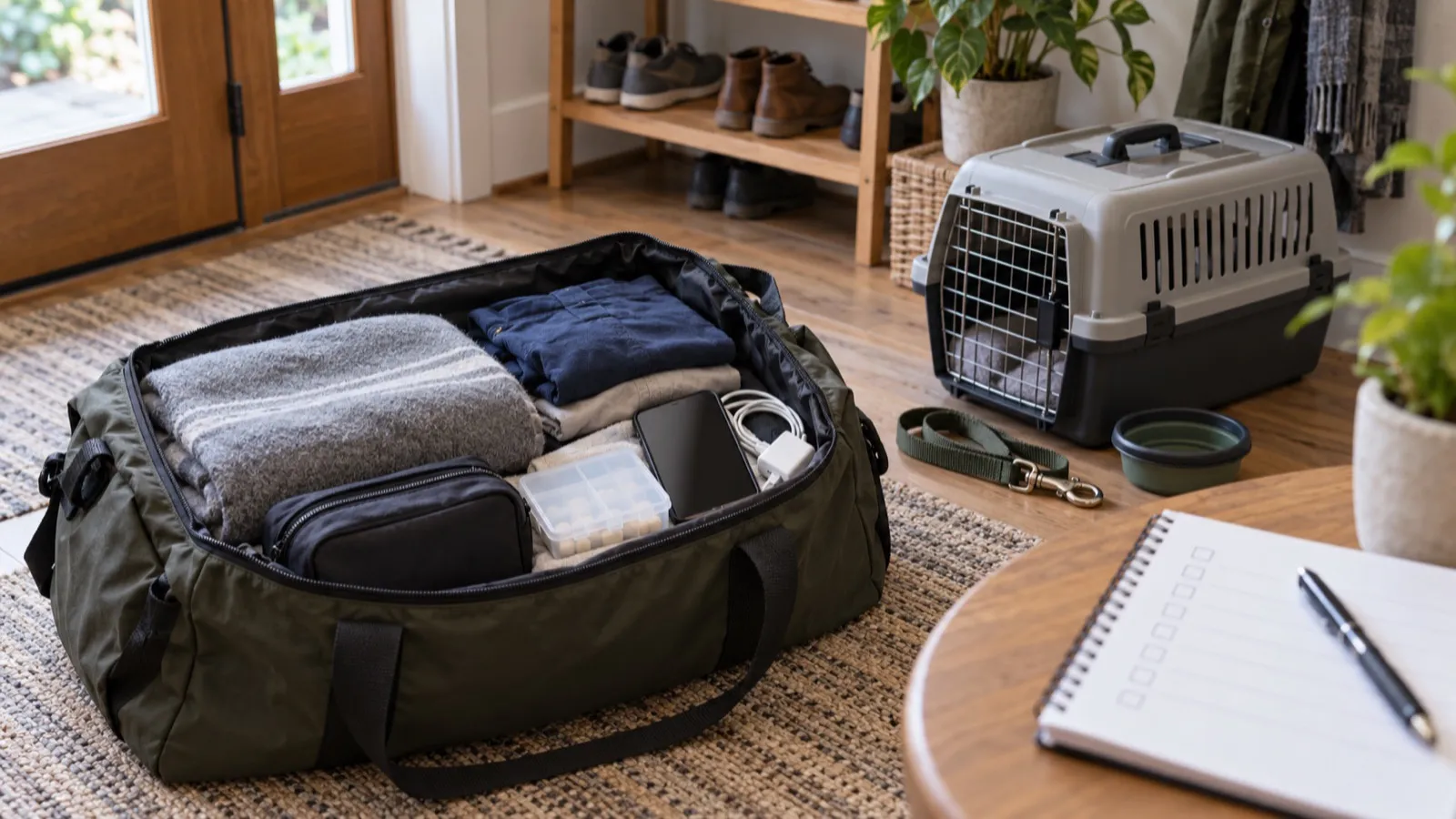
When local emergency authorities issue an evacuation order, speed and verified destination status determine safety. Arriving at a designated shelter requires confirming that the facility is open, operational, and equipped to handle specific household requirements such as medical equipment, dietary needs, or pets.
Worked Sizing & Physics Calculation: Evacuation Timing & Go-Bag Capacity
To ensure rapid mobilization during an emergency, households must balance supply completeness with weight and volume constraints.
- Departure Time Window: Standard emergency response guidelines recommend a maximum 15-minute departure window from the moment an evacuation order is issued.
- Go-Bag Weight & Volume Limits: For an adult carrying a backpack on foot or transferring between vehicles, ergonomic standards limit total pack weight to no more than 20% to 25% of body weight (e.g., max 30-35 lbs for a 150-lb adult).
- Water and Calorie Rationing per Person:
- Water: Minimum 1 gallon per person per day (for a 3-day shelter transition kit, this represents ~25 lbs of water alone; carrying bottled water in a vehicle is practical, but foot transit requires prioritizing purification filters or carrying a portable 1-liter flask).
- Calorie density: High-calorie compact rations (~2,400 kcal per 1-lb food bar) minimize pack bulk.
Confirm the Site Before Traveling
Use the local emergency-management source for the current evacuation destination and shelter list. The American Red Cross find-an-open-shelter map distinguishes overnight shelters from other disaster-relief service sites; some listings are partner locations. Check the symbol, address, hours or opening information, and whether the place is intended for overnight stays. If local officials direct evacuees to a temporary point first, follow that instruction.
When information is unclear, ask the local emergency office or shelter operator:
- Is this location currently open and accepting people, and where should we enter?
- Is it an overnight shelter or a service site with limited hours?
- Can the household bring a pet? Will animals stay with people or in a separate area?
- What should someone bring for a service animal, and where may the animal be relieved?
- What access, charging, refrigeration, communication, or mobility arrangements are available?
- Is registration required, and what information should we have ready?
The Red Cross states that its shelters welcome service animals and household pets, though pets may be housed separately depending on the situation. That does not confirm the arrangement at a particular site. Ask the operator before traveling when time and conditions permit. Keep the animal restrained and bring its food, medication, identification, and familiar supplies if available.
Pack the Essentials You Can Carry
The Red Cross recommends taking items such as bedding, clothing, medicines, a child’s comfort item, and an emergency kit if there is time. Add the things your household needs to function: mobility or hearing aids, chargers, glasses, care supplies, important phone numbers, and a small amount of familiar food for dietary needs. Keep medicines with the person who needs them and follow their storage instructions. A shelter’s specific supplies and services can change; do not assume it can replace a medication, device, caregiver, or specialized food.
Use a compact bag that the assigned person can carry. Keep a contact card and essential care information with the responsible person, not loose in shared areas. Ask before bringing large items that may block exits or limit space. Do not bring weapons, alcohol, or illegal drugs to a Red Cross shelter, consistent with its published guidance.
Shelter Visit Check Record
| Check | Current answer | Who Should Skip It / Fails When |
|---|---|---|
| Official shelter map status confirmed active? | Fails when: Relying on outdated social media posts or yesterday’s shelter list. | |
| Pet policy verified for this specific site? | Skip if: The facility does not permit animals and alternate boarding is arranged. | |
| 3-day supply of prescription medication packed? | Fails when: Leaving vital daily medications behind during a rushed departure. | |
| Mobility aids and chargers secured? | Fails when: Wheelchairs or assistive devices lack backup batteries or power cords. | |
| Emergency contact card in physical wallet? | Fails when: Relying solely on a smartphone with a dead battery. |
During an emergency, prioritize immediate personal safety and adherence to official evacuation routes over packing non-essential items. Once settled at a verified shelter, register with family notification networks (such as the Red Cross “Safe and Well” registry) to inform distant relatives of your status.