
In this guideJump to a section
An outdoor practice is planned for tomorrow, while smoke is changing the view outside today. The daily forecast and the current AirNow number can answer different timing questions. Read the pollutant and the matching health message before comparing those two displays, then choose a time to check conditions again.
Read four things in order
| Look for | Why it matters | Note for your plan |
|---|---|---|
| Pollutant | AQI covers ozone, particle pollution, carbon monoxide, nitrogen dioxide, and sulfur dioxide; the underlying time frame differs by pollutant | Record the pollutant shown, especially when smoke is the concern |
| Category and health message | The color/category explains who may be affected and offers exposure-reduction steps | Read the message, not color alone |
| Current NowCast | AirNow calculates current AQI for ozone and particle pollution from the most recent available hour and multiple hours of data | It can change as conditions change |
| Forecast | Local/state forecasters estimate expected AQI for a future period, often the next day | Check again because forecasts can change |
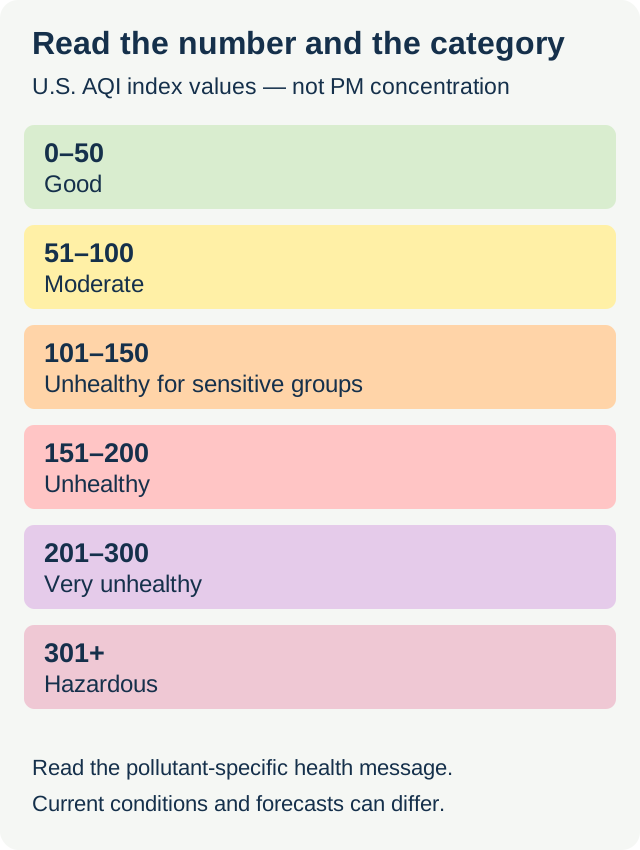
Use these six AirNow category bands: Good 0–50; Moderate 51–100; Unhealthy for Sensitive Groups 101–150; Unhealthy 151–200; Very Unhealthy 201–300; and Hazardous 301 or higher. AQI is an index value, not a particle concentration such as micrograms per cubic meter. The category’s health message is part of the reading, especially above 100, when AirNow says air quality is unhealthy. AirNow’s category table and pollutant list give the full public definitions.
AirNow’s NowCast is not simply a single instantaneous sensor reading. For particle pollution, its calculation can use shorter or longer averaging depending on how quickly conditions are changing. A forecast is a prediction, not a measurement of what is happening at this moment. AirNow distinguishes the daily index, next-day forecast, and current NowCast; the NowCast covers ozone and particle pollution, while forecast availability and timing can vary by locality.
Turn the reading into one activity choice
Suppose a household plans a long outdoor practice during a smoky afternoon. Check the current particle-pollution NowCast and the daily forecast; read the AirNow message for the pollutant and affected groups. If the local forecast discussion suggests a lower-pollution time, consider shifting the activity and check current conditions before leaving. If conditions worsen, shorten, move, or cancel the activity in line with local public-health instructions. The forecast can help compare timing, but it does not promise that a later hour will be cleaner.
This example shows a way to use the information; it does not set a universal AQI cutoff. A person’s sensitivity, activity, local advice, and medical needs can change the right choice. People with individual health questions should seek advice from their clinician.
If AirNow does not show a nearby monitor
Use the state, local, or tribal air agency linked from official sources and read the coverage notes. A monitor may be some distance away, and local smoke can vary across neighborhoods. Do not treat a missing reading as proof of clean air. Check current official smoke and emergency updates as well.
For reducing indoor particle exposure, the wildfire clean-air room guide covers room selection, filtration limits, heat, and reasons to leave. This article explains how to read air-quality information; it is not a live AQI map or a medical instruction.