In this guide Jump to a section
- Start with the daily load you must replace: essentials only, in watt-hours per day
- Why winter solar output is so much lower than summer
- The winter solar math, step by step
- Critical winter hardware hazard: cold-weather Open-Circuit Voltage (Voc) spikes
- Winter solar setup and Voc safety checklist
- Frequently asked questions
A “200-watt” foldable solar panel almost never produces 200 watts for eight hours a day—and in the middle of a December or January power outage, expecting summer-level recharge speeds can leave your household with a dead battery by day two.
While our year-round solar sizing guide explains general photovoltaic sizing, winter solar charging introduces three harsh physical constraints that require dedicated math: low sun angles and short Peak Sun Hours, frozen LiFePO4 battery charge lockouts, and cold-weather open-circuit voltage (Voc) spikes that can permanently fry a power station’s charge controller if you wire panels in series without checking the temperature margin.
Start with the daily load you must replace: essentials only, in watt-hours per day
Before buying extra solar panels, strip your winter outage load down to the non-negotiable watt-hours your household consumes every 24 hours:
- Medical & Nighttime Safety: CPAP machine on DC adapter (
200 Wh/night), rechargeable LED lanterns (30 Wh/day), and phone/radio charging (40 Wh/day). - Communications: Home Wi-Fi router and fiber ONT (
20 W × 12 hours = 240 Wh/day). - Cold Chain / Heating Control: In a deep freeze, you may need
1,200 Wh/dayfor a kitchen refrigerator or2,400 Wh/dayfor a natural gas furnace blower. - Total Daily Target to Replenish: Whether your daily essential target is
510 Wh/day(electronics + CPAP) or1,500 Wh/day(adding refrigeration), your winter solar array must replace that exact number of watt-hours inside a narrow 3-to-5-hour midday sun window.
High-Output Upgrade · 220W Bifacial
EcoFlow 220W Bifacial Solar Panel
- Open-circuit voltage (Voc)
- 21.5 V
Why it fits Captures ambient sunlight from the front and snow/ground albedo reflection from the back, boosting winter power generation by up to 25% during short peak sun windows.
Key trade-off Manual ratings are under its stated standard test conditions: 1,000 W/m², AM1.5, 25°C. Front 220±5 W and rear 175±5 W are separate side ratings; do not add them as guaranteed or expected combined output. Rear capture depends on reflected light.
Specifications & research
220W Bifacial portable solar panel with snow-albedo capture. Source records checked on 2026-10-25. Manufacturer research, not hands-on testing.
- Rated panel power
- 220 W · Source checked 2026-10-25
- Open-circuit voltage (Voc)
- 21.5 V · Source checked 2026-10-25
- Listed panel weight
- 15.4 lb · Source checked 2026-10-25
Manufacturer documentation. Check the exact station limits and keep the rear-side rating separate from the front-side nameplate; no universal compatibility is established.
Why winter solar output is so much lower than summer
A solar panel’s 200 W nameplate rating is measured in a factory flash tester under Standard Test Conditions (STC): 1,000 W/m² of direct perpendicular light at 77°F (25°C). In winter, four factors compress your daily harvest:
- Fewer Peak Sun Hours (
1.5 to 3.5 hours/day): Even if the sun is above the horizon from 7:30 AM to 4:30 PM (9 hours of daylight), low winter sun angles mean the sun’s rays pass through a much thicker slice of atmosphere. In northern and mid-latitude U.S. states, total daily solar irradiance in December/January often equals just 1.5 to 3.5 Peak Sun Hours (kWh/m²/dayon NREL’s PVWatts calculator). - Steep Panel Tilt Geometry (
50° to 65°Required): Because the winter sun sits low in the southern sky (20°–35°above the horizon at solar noon), laying a portable solar panel flat on the ground (0°) or at a shallow summer kickstand angle (30°) loses30%–45%of available light. In winter, prop portable panels steeply at 50° to 65° facing true south—and re-aim them at 10:00 AM, 12:00 PM, and 2:00 PM. - Snow, Frost, and Partial Cell Shading: Even a thin strip of snow or a leafless tree branch shading the bottom row of cells on a foldable panel can drop the entire panel’s current output by
50%–80%. - Overcast Storm Tail: During active snowstorms or thick stratus cloud cover, solar irradiance drops to
10%–20%of clear-sky levels (a200 Wpanel may trickle in just15 W to 35 W).
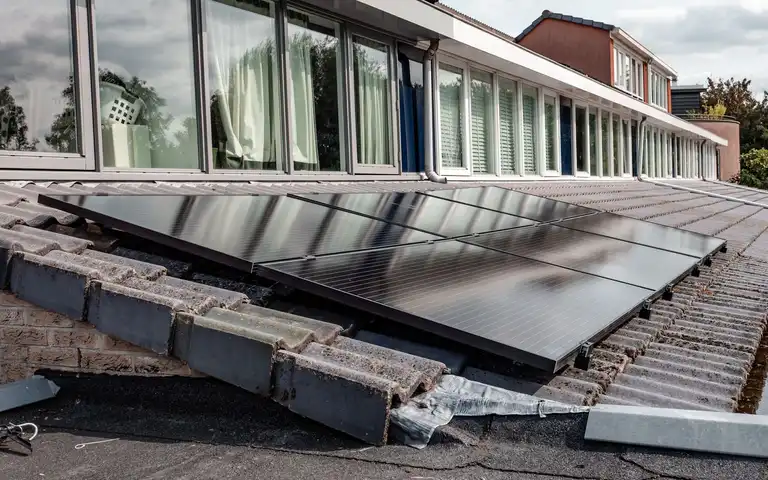
Set portable solar panels outdoors at a steep 55°–60° tilt facing south, and run a long DC cable indoors so the LiFePO4 battery stays warm enough (>32°F) to accept the charge.
The winter solar math, step by step
Use this two-part equation to size your portable solar array honestly:
- Daily Energy per Panel (Wh/day):
Daily Wh = Rated Panel Watts × Winter Peak Sun Hours × System Loss Factor - Number of Panels Needed for a 1-Day Recharge:
Panels Needed = Target Energy to Replace (Wh) ÷ Daily Wh per Panel
Worked Example 1: Recharging a 1,024 Wh Power Station in Winter
Suppose you own a 1,024 Wh portable power station and a 200 W foldable solar panel. Using an illustrative winter assumption of 3 Peak Sun Hours and a 0.75 system loss factor (accounting for real-world angle, wiring, dust, and MPPT conversion losses):
- Daily Yield from One 200 W Panel:
200 W × 3 Peak Sun Hours × 0.75 = 450 Wh per clear winter day - How Many Panel-Days to Replace 1,024 Wh?
1,024 Wh ÷ 450 Wh/day = 2.28 panel-days - What That Means for Your Hardware Plan:
- With 1 × 200 W Panel (
200 Warray): It takes roughly 2.3 clear winter days (nearly three days) to fully recharge a drained 1,024 Wh battery—or it lets you sustainably consume450 Wh/dayindefinitely on clear days. - With 2 × 200 W Panels (
400 Warray): Produces2 × 450 Wh = 900 Wh/day, recharging the 1,024 Wh station from 10% to 98% in one clear winter day (and fits within the400 Wsolar ceiling of stations like the Jackery 1000 v2). - With 3 × 200 W Panels (
600 Warray): Produces3 × 450 Wh = 1,350 Wh/day, easily completing a 1-day full recharge even if haze trims sun hours to 2.3 hours (requires a power station with at least a600 Wsolar input limit, such as the Anker SOLIX C1000 or BLUETTI Elite 100 V2).
- With 1 × 200 W Panel (
Replace 3 Peak Sun Hours and 0.75 with the December/January values for your zip code from NREL PVWatts.
Winter solar output matrix across climates and panel sizes
| Solar Array Rating | Northern / Cloudy Winter (1.5 Peak Sun Hours, 0.75 factor) | Mid-Latitude Clear Winter (3.0 Peak Sun Hours, 0.75 factor) | Sunbelt / High-Altitude Winter (4.5 Peak Sun Hours, 0.75 factor) | Max Station Input Needed |
|---|---|---|---|---|
1 × 100 W Panel (100 W) | 112 Wh/day (9.1 days for 1 kWh) | 225 Wh/day (4.5 days for 1 kWh) | 338 Wh/day (3.0 days for 1 kWh) | 100 W+ MPPT port |
1 × 200 W Panel (200 W) | 225 Wh/day (4.5 days for 1 kWh) | 450 Wh/day (2.3 days for 1 kWh) | 675 Wh/day (1.5 days for 1 kWh) | 200 W+ MPPT port |
2 × 200 W Panels (400 W) | 450 Wh/day (2.3 days for 1 kWh) | 900 Wh/day (1.1 days for 1 kWh) | 1,350 Wh/day (0.8 days for 1 kWh) | 400 W+ MPPT port |
3 × 200 W Panels (600 W) | 675 Wh/day (1.5 days for 1 kWh) | 1,350 Wh/day (0.8 days for 1 kWh) | 2,025 Wh/day (0.5 days for 1 kWh) | 600 W+ MPPT port |
Critical winter hardware hazard: cold-weather Open-Circuit Voltage (Voc) spikes
While cold temperatures block LiFePO4 batteries from charging below 32°F, cold air has the opposite effect on solar panels: solar silicon cells produce higher voltage as temperature drops below 77°F (25°C).
Every portable power station has a strict Maximum Solar Input Voltage (V_max)—commonly 60V DC on 1 kWh power stations. Exceeding 60V by even a few volts can permanently burn out the internal MPPT charge controller MOSFETs, which is never covered by warranty.
Worked Example 2: Why Three 21.6V Panels in Series Fry a 60V Controller at 10°F
Suppose you have three 200 W solar panels, each with a rated Open-Circuit Voltage (Voc) of 21.6V at 77°F (25°C), and you wire all three in series (positive-to-negative) to connect to a power station with a 60V max solar limit:
- Room-Temperature Series Voltage (
77°F / 25°C):3 × 21.6V = 64.8V(already over60V!). - Even with Two Panels of a Higher-Voltage Design (
27.5V Voc each):- At
77°F (25°C):2 × 27.5V = 55.0V(looks safe under60V!). - At
5°F (-15°C)on a crisp winter morning (40°Ccolder than the25°Crating, with a typical-0.30% per °Ctemperature coefficient, or a1.12×cold multiplier): - Cold Winter
Voc:55.0V × 1.12 = 61.6V— exceeds the 60V MPPT limit and damages the power station!
- At
Safety Rule: Always leave at least a 15% to 20% voltage buffer below your power station’s maximum solar input voltage (
keep rated 25°C series Voc ≤ 48V–50V on a 60V max port), or wire multiple panels in parallel (which adds amps while keeping voltage at a single panel’s safe21.6V–27.5Vlevel).
Winter solar setup and Voc safety checklist
Follow this step-by-step checklist when setting up portable solar panels in winter:
- Keep the Power Station Indoors and Run a 25–50 ft Solar Extension Cable Outside: Never place your LiFePO4 power station out in the snow next to the panels. Keep the battery at
65°Findoors and pass a10 AWGor12 AWGMC4 extension cable through a foam-sealed window slot. - Check Series
Voc× 1.15 Against Your Station’s Max Voltage Limit: Multiply the sum of your series-connected panels’Voclabels by1.15. If that number exceeds the station’s max input voltage (e.g.,60V), switch to a parallel Y-branch connection. - Prop Panels at a Steep 55°–60° Tilt Facing True South: Steep tilt angles capture low winter sun rays perpendicularly and help snow slide off the glass/ETFE surface automatically.
- Brush Frost and Snow Off Completely Before 9:00 AM: Even a 2-inch band of packed snow along the bottom edge of a foldable panel can choke current across the entire string; use a soft foam snow brush (never a metal ice scraper).
- Anchor Foldable Panels Against Winter Wind Gusts: Steeply tilted foldable panels act like sails in winter gusts; stake down the kickstand grommets or weight the rear legs with sandbags.
Frequently asked questions
How much power does a solar panel make in winter?
Multiply the panel’s rated watts by your winter Peak Sun Hours, then multiply by a real-world system loss factor (typically around 0.75). As an illustration, a 200 W panel receiving 3 Peak Sun Hours with a 0.75 loss factor produces 200 × 3 × 0.75 = 450 Wh of energy on a clear winter day. Because winter sun hours are much shorter than summer and clouds or snow cut output further, check NREL’s PVWatts calculator for your address and replace these assumptions with your local winter numbers.
How many panels do you need to recharge a 1,024 Wh power station?
Divide the watt-hours you need to replace by what a single panel produces in a winter day. If you want to replace 1,024 Wh and one 200 W panel generates 450 Wh/day, then 1,024 ÷ 450 = 2.28 panel-days—meaning you need three 200 W panels (600 W total) for a single-day winter recharge (if your station accepts 600 W of solar input), or one 200 W panel over roughly 2.3 clear days. Always keep the power station indoors above 32°F so its battery accepts the charge.