The instant utility power snaps back on after an extended blackout, electrical distribution feeders experience sudden transient voltage spikes and severe frequency oscillations. When a utility substation re-energizes thousands of homes simultaneously, switching surges routinely send line voltage swinging between 100V and 145V for the first several minutes. Rushing to turn on every household appliance the second overhead streetlights illuminate risks destroying compressor motors, tripping sensitive circuit breakers, or igniting compromised wiring.
A glowing ceiling light confirms only that voltage is present at the service entrance meter. It does not establish that municipal water pressure is biologically safe, that your basement sump pump is dry enough to energize without shock hazard, or that perishable milk in the refrigerator remained below bacterial growth thresholds.
Stop at immediate hazards
The first 15 minutes after power returns represent the highest risk window for home electrical fires and electrocution. Grid switching equipment at nearby substations often trips and resets automatically (recloser cycles). If an energized distribution line is still touching tree limbs down the street, voltage may cycle on, cut off violently, and surge back on multiple times.
Before interacting with household equipment, complete these physical stop checks:
- Smell for Electrical Ozone or Acrid Plastic Smoke: Walk slowly through living spaces and near the main electrical service panel. Overheated breaker connections or surge-damaged appliances release a sharp, fishy or chemical plastic burning odor. If you smell burning, immediately cut power at the main service disconnect and summon emergency services.
- Scan Basements and Utility Closets for Standing Water: Under no circumstances should you walk into a flooded basement or utility room where electrical outlets, extension cords, sump pumps, or water heaters are partially submerged. Water conducts lethal electrical current from damaged wiring directly into standing water.
- Execute Safe Portable Generator Shutdown: If you operated a portable generator during the blackout, never switch on utility breakers while the generator is still plugged into an inlet or running. Turn off generator circuit breakers first, disengage the mechanical interlock or transfer switch, switch off the generator engine, and allow it to cool for at least 15 minutes before touching exhaust or fuel components per Consumer Product Safety Commission guidelines.
Cold-Load Pickup Math: Why Simultaneous Restart Trips Breakers
When an entire neighborhood loses power for hours in freezing winter or blistering summer, every thermostatically controlled device cools down or warms up past its setpoint. The moment grid power returns, every refrigerator, freezer, water heater, heat pump, and well pump attempts to start at the exact same second. Utilities refer to this massive surge as cold-load pickup.
Inside a single household, the math reveals why turning on all breakers at once causes severe equipment stress:
- Sump Pump (1/2 HP): 950W running, 2,150W startup surge (18.7A at 115V)
- Kitchen Refrigerator (1/3 HP): 700W running, 1,800W startup surge (15.6A at 115V)
- Upright Chest Freezer: 500W running, 1,400W startup surge (12.2A at 115V)
- Central Air Conditioner Compressor (3-Ton): 3,500W running, 8,200W locked-rotor surge (35.6A at 230V)
If all four mechanical units attempt to start simultaneously when the main service energizes: Total Instantaneous Inrush Current = 18.7A + 15.6A + 12.2A + (35.6A × 2) = 117.7 Amperes of combined 120V-equivalent starting current.
This massive instantaneous draw pulls household voltage down below 92V for several seconds. Motors starved of starting torque hum loudly in a locked-rotor state, overheating internal start windings and tripping individual thermal overload switches. Staggering circuit breaker re-activation over 30 to 45 minutes eliminates this coincident peak inrush entirely.
Post-outage checklist
Follow this prioritized decision matrix to inspect household systems in strict order of physical hazard:
| Household System | Primary Inspection Checkpoint | Quantitative Pass / Fail Metric | Immediate Corrective Action | Operating Limit / Who Should Skip It |
|---|---|---|---|---|
| Main Service Panel | Visual inspection of main breaker and branch handles | Breakers cool to the touch; no buzzing, arcing, or acrid odor | If main breaker hums or trips immediately, leave off; call utility | Skip testing interior panel lugs. Live 240V bus bars carry lethal arc-flash risk; never remove deadfront cover. |
| Generator Connection | Transfer switch / mechanical interlock status | Generator fully isolated, engine cooled, fuel shutoff valve closed | Switch transfer mechanism back to “Utility”; disconnect cord | Fails if engine is refueled hot. Spilled fuel on hot exhaust (500°F+) causes instant flash fire; wait 15 min. |
| Basement / Sump Pump | Water level in pit relative to pump motor housing | Sump pit water clears within 10 minutes of re-energizing | If pump hums without pumping, check discharge check valve | Skip if water covers electrical outlet. Do not enter standing water to plug in pump; trip breaker remotely. |
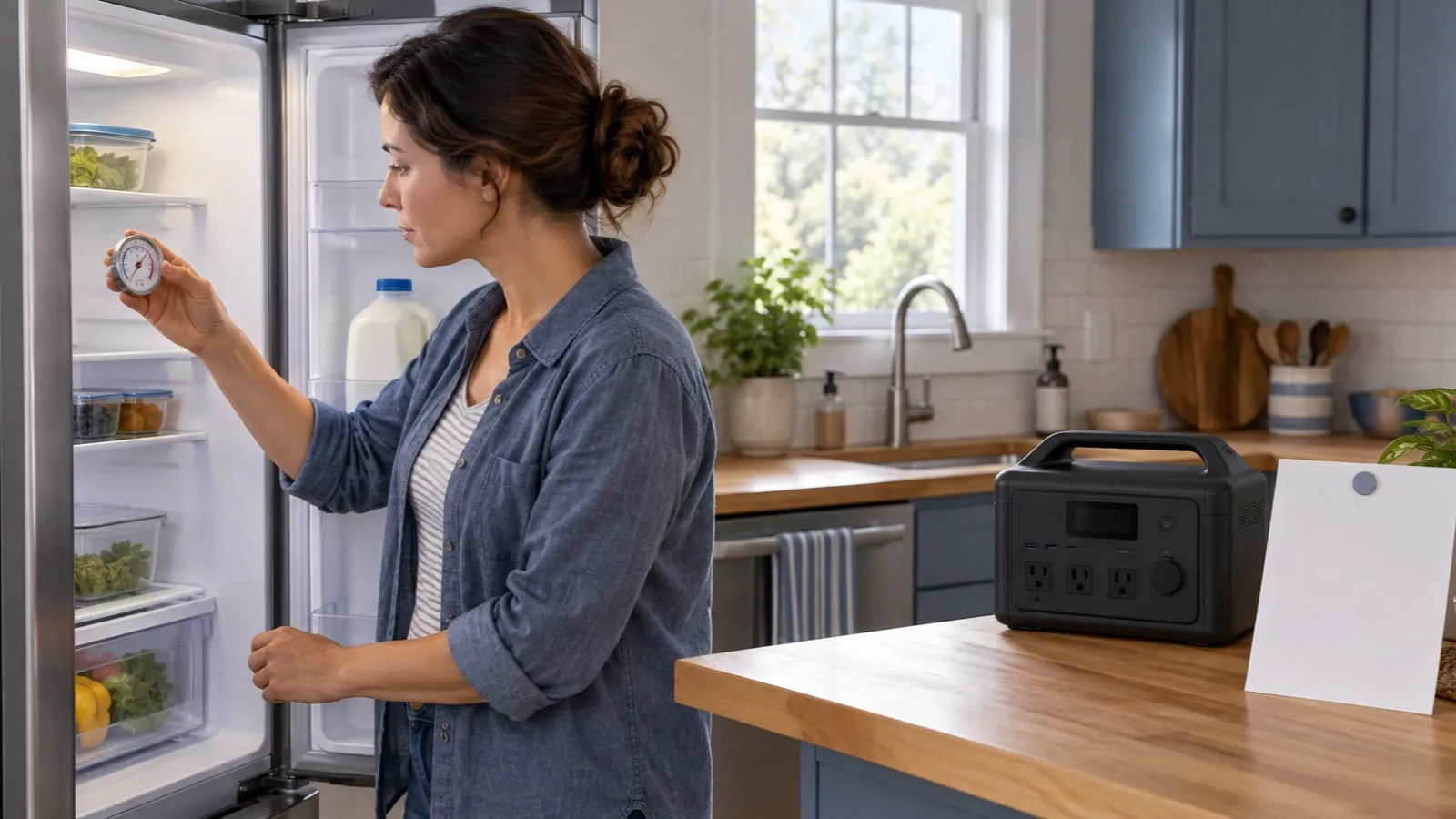
| Refrigerator & Freezer | Internal liquid or digital probe thermometer reading | Cabinet air temperature must be at or below 40°F (4.4°C) | Keep doors sealed until power is stable; discard items > 40°F | Fails if relying on smell/taste. Pathogenic bacteria (Salmonella, E. coli) produce zero odor or visual change. |
| Municipal Tap Water | Local utility health notices and boil-water alerts | System pressure maintained (>20 psi); no official boil order | If boil advisory active, bring water to a rolling boil for 1 full minute | Skip using ice makers or water dispensers. Discard first 3 batches of ice and flush internal refrigerator lines. |
| Electronics & Smart Hubs | Status LEDs on router, ONT, and primary security hub | Solid green/white WAN status; steady voltage on UPS displays | Power cycle network hardware in sequence: ONT first, then router | Skip resetting equipment repeatedly. Rapid power toggling corrupts solid-state flash memory and firmware. |
Check food by official temperature guidance
Food safety following an electrical outage is strictly governed by bacterial reproduction kinetics, not subjective appearance or sniff tests. FoodSafety.gov and the USDA Food Safety and Inspection Service establish non-negotiable temperature thresholds:
- The Danger Zone: Bacteria multiply exponentially between 40°F (4.4°C) and 140°F (60°C).
- The Two-Hour Rule: If perishable refrigerated foods—including raw meat, poultry, seafood, milk, soft cheeses, cooked leftovers, and cut melons—have spent more than 2 hours above 40°F, they must be thrown in the trash. If ambient room temperature exceeds 90°F (such as during a summer heatwave blackout), that safety window shrinks to 1 hour.
- Freezer Integrity: A fully stocked chest freezer will maintain safe sub-40°F temperatures for approximately 48 hours if the door remains completely closed. A half-full freezer holds temperature for roughly 24 hours.
- Refreezing Rules: Food that still contains visible ice crystals or measures 40°F or below on a calibrated food probe thermometer can safely be refrozen, though texture and moisture quality may degrade. If thawed meat or poultry reached room temperature, discard it immediately.
Never taste food to determine if it is spoiled. Toxic bacterial byproducts like Staphylococcus enterotoxins are heat-stable and odorless; cooking spoiled food does not make it safe.
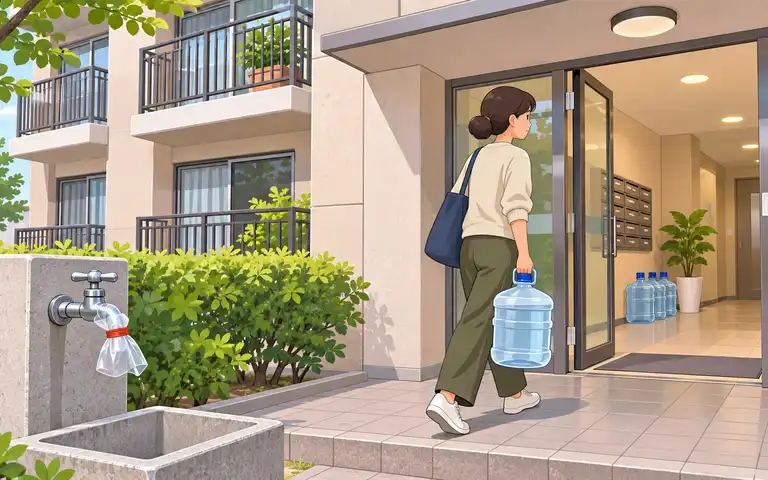
Check water by the notice, not the light switch
When a wide-area power failure strikes, municipal water treatment facilities and distribution booster pumping stations often lose line power. If distribution pressure drops below 20 psi (pounds per square inch), groundwater containing soil microbes, animal waste, and agricultural chemicals can siphon backward into municipal water mains through microscopic cracks and joint seals (backsiphonage).
Even though tap water flows from your kitchen faucet when power returns, that water may be biologically contaminated until municipal laboratories complete 24- to 48-hour coliform bacterial incubation tests.
- Verify Water Provider Status: Access your municipal water authority website or municipal emergency broadcast. Check whether your specific street or pressure zone is under a Boil Water Advisory, Do Not Drink Advisory, or Do Not Use Advisory.
- Understand Boil Water Protocol: If a Boil Water Advisory is in effect, bringing water to a vigorous rolling boil for 1 full minute (or 3 full minutes at altitudes above 6,500 feet) kills all pathogenic bacteria, viruses, and protozoan cysts (such as Giardia and Cryptosporidium). Cool the boiled water in sanitized containers before drinking or brushing teeth.
- Flush Interior Household Plumbing: Once your municipal provider officially lifts the advisory, open every cold water faucet in the home and run water continuously for 5 minutes to clear stagnant water from interior pipes. Discard all ice from automatic ice makers, run the water dispenser for 1 gallon, and run an empty hot cycle on dishwashers and clothes washers.
If your home relies on a private well, inspect the wellhead casing before restoring power to the pump breaker. If floodwaters submerged the wellhead, do not drink the water or run household taps. Submerged wells require chemical shock-chlorination and certified laboratory testing before human consumption.
Restore normal use in small steps
Once life-safety hazards and food-storage audits are resolved, execute a disciplined, gradual return to normal household energy consumption. Avoid flipping every wall switch and re-energizing large heating or cooling elements within the first hour of grid reconnection.
Post-Restoration Device Clearance Sequence
- Reset Tripped GFCI and AFCI Receptacles: Ground-Fault Circuit Interrupters (GFCI) and Arc-Fault Circuit Interrupters (AFCI) are sensitive solid-state protection devices. Utility switching transients routinely trip these devices when power snaps back on. Walk through bathrooms, kitchens, garages, and outdoor receptacles, pressing the “Reset” button firmly. If a GFCI breaker refuses to reset and trips instantly with nothing plugged in, an internal surge has destroyed the device.
- Inspect Surge Protective Devices (SPDs): Examine the diagnostic indicator LEDs on whole-house panel surge protectors and point-of-use surge strips. A red light or extinguished “Protected” LED indicates the internal Metal Oxide Varistors sacrificed themselves to absorb the utility reconnection surge and no longer provide surge protection.
- Examine the Refrigeration Defrost Timer: Modern digital refrigerators occasionally lock their control boards in an error state after an abrupt power interruption. Verify that the compressor hums to life within 10 minutes of re-energizing and that cold air discharges from interior vents. If the display shows a flashing error code, consult the user manual for the specific button-combination hard reset sequence.
- Re-Establish Smart Home and Communication Hardware: Bring network infrastructure back online in strict sequential order. Power on the fiber Optical Network Terminal (ONT) or cable modem first. Wait 5 full minutes until the upstream and downstream WAN lights turn solid green. Next, power on your primary Wi-Fi router, and finally re-energize remote mesh nodes, security cameras, and home automation bridges.
- Document Losses for Insurance Claims: Take clear, date-stamped photographs of discarded spoiled groceries, damaged electrical equipment, or water intrusion before disposing of items. Keep a detailed itemized inventory with estimated replacement costs; many homeowner insurance policies cover food spoilage losses resulting from widespread utility outages above specified deductible thresholds.
- Prepare Backup Equipment for Long-Term Storage: If a portable generator was deployed, turn the fuel petcock valve to “Off” while the engine is running and let the engine stall naturally. This purges remaining fuel from the carburetor float bowl, preventing ethanol gumming and jet clogging during future emergency storage.