INFO
Keep two short water cards. The routine PFAS card names the latest water report or laboratory result, exact certified filter claim, capacity, and replacement date. The emergency card names the stored source, current advisory, and the alternate source to use when contamination is unknown.
PFAS planning is easy to confuse with emergency disinfection. They solve different problems. Boiling and chemical disinfection can address germs when used correctly. They do not remove PFAS from water; the EPA PFAS questions and answers specifically confirms the boiling limitation.
An emergency also does not prove that a source contains PFAS. Start with actual utility data, a qualified laboratory result, or a health department notice. If the source is unknown after a flood, fire, or industrial incident, use stored or bottled water and follow local officials rather than guessing at a filter stack.
Current federal rule status
Status checked September 30, 2026. EPA rulemaking is active, so recheck the linked EPA pages before relying on a compliance date.
EPA finalized the first national PFAS drinking-water regulation in April 2024. The final rule established enforceable limits that include 4 parts per trillion for PFOA and 4 parts per trillion for PFOS.
On May 18, 2026, EPA announced two proposed rules. One proposal would uphold the PFOA and PFOS limits while allowing eligible public water systems to request up to two additional years, through 2031, to comply. A separate proposal would rescind the regulations for PFHxS, PFNA, HFPO-DA, and the Hazard Index mixture.
The public-comment period for the compliance-extension proposal closed July 20, 2026. Both 2026 actions remain proposals, not completed replacements for the 2024 final rule. Check EPA’s current pages before relying on a compliance date or making a major water decision:
- EPA final PFAS drinking-water regulation and current status
- EPA proposed PFOA and PFOS compliance extension rule
- EPA proposed PFAS rescission rule
PFAS is a different treatment problem
PFAS are dissolved chemicals. Emergency methods built around pathogens should not be assumed to remove them.
| Method | Useful emergency role | PFAS boundary |
|---|---|---|
| Boiling | Kills germs when used as directed | Does not remove PFAS |
| Household bleach | Disinfects many germs when used according to CDC instructions | Does not remove PFAS |
| UV treatment | Inactivates germs under the device’s operating conditions | Does not remove PFAS |
| Common portable microfilter | May remove organisms named on its label | Do not assume PFAS reduction without an exact certified claim |
| Activated carbon, ion exchange, or RO | Can reduce selected PFAS when the exact product and claim are verified | Capacity, maintenance, PFAS type, and certification scope matter |
Do not use boiling as a PFAS treatment. Do not add more disinfectant. Do not assume improved taste means PFAS has been reduced.
Emergency priority: stored safe water
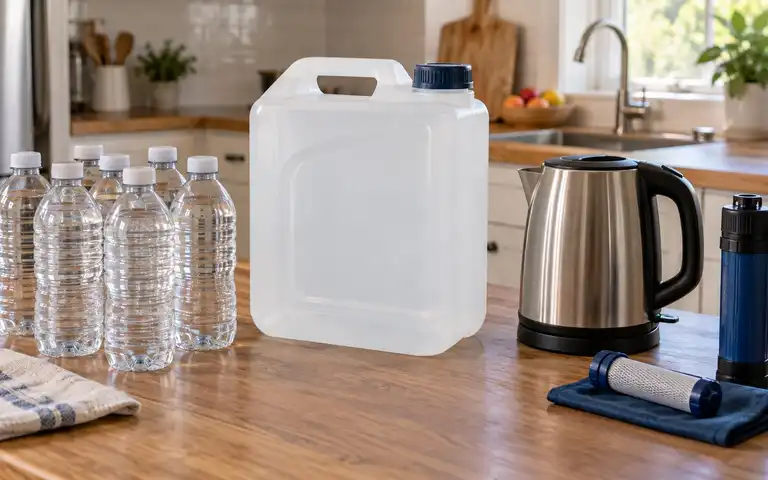
The most reliable first layer is water that was safe when stored.
The CDC emergency water supply guide recommends at least 1 gallon per person per day for 3 days and says to try to store a 2-week supply if possible.
Use the Water Storage Calculator for your household baseline and additional reserve. If your utility reports PFAS, ask whether the tap water is currently within applicable limits and what source it recommends for emergency storage.
Commercially bottled water and home-filled tap water are not automatically PFAS-free. Use current source information. The point of storage is to preserve a known safe supply, not to postpone an unresolved contamination question.
When an incident changes the source
Routine service interruption
Use your known stored supply. A loss of pressure does not by itself tell you whether PFAS is present, but it can create other contamination concerns. Follow the utility advisory.
Boil-water advisory
Boiling addresses the germ risk described by the advisory. It does not address PFAS. Follow the utility’s exact instructions and use another source if officials issue a do-not-drink notice.
Flood, fire, or industrial release
Unknown water can contain both germs and chemicals. The CDC says water contaminated with fuel or toxic chemicals cannot be made safe by boiling or disinfection. Use another safe source and wait for local testing and instructions.
Private well
Private wells are not regulated like public water systems. If PFAS is a concern, use a qualified laboratory and work with the health department on sampling and interpretation. After flooding, follow separate well disinfection and testing guidance for germ risks.
What home filters can do
EPA identifies granular activated carbon, ion exchange resin, and reverse osmosis as point-of-use technologies that can greatly reduce PFAS when properly selected and maintained.
EPA’s filter page includes a certification warning explicitly dated April 2024: the criteria then in use did not establish reduction to the federal drinking-water levels. For a purchase now, check the exact model’s current certified claim and test conditions. A PFAS reduction claim alone does not guarantee that your household water meets those limits.
For a home filter:
- Find out which PFAS were measured in your water.
- Verify the exact model in a current accredited certification listing.
- Confirm an NSF/ANSI 53 or NSF/ANSI 58 PFAS reduction claim, not just the standard number.
- Check which PFAS the claim covers.
- Follow capacity and replacement instructions.
- Keep the filter record with the water report.
Use EPA’s guide to certified PFAS filters and NSF’s water filter FAQ. For the purchase decision, continue to the PFAS Home Filter Guide.
What not to do
- Do not buy from a generic “removes contaminants” statement.
- Do not assume a backpacking filter addresses dissolved chemicals.
- Do not rely on a certification logo without checking the exact model and claim.
- Do not keep using a cartridge beyond its rated life.
- Do not use emergency floodwater because it looks clear.
- Do not substitute a home filter for a do-not-drink advisory.
- Do not repeat old rule dates without checking EPA’s current rule and proposal pages.
A two-plan household setup
Keep the PFAS plan and the emergency germ plan connected but separate.
Routine PFAS plan:
- Current utility report or qualified well test.
- Filter with a verified claim if needed.
- Installation and replacement record.
- Retesting or report-review schedule based on local guidance.
Emergency plan:
- Known safe stored water.
- Utility and health department contacts.
- CDC boiling and disinfection instructions for germ advisories.
- A firm rule to reject water with suspected fuel or toxic chemicals.
Read the Emergency Water Safety Guide for the complete decision tree and Water Treatment Methods for method-specific limits.
PFAS emergency water FAQ
- Does boiling water remove PFAS?
- No. Boiling kills germs when used as directed, but it does not remove PFAS. Follow the current advisory and use another safe source when directed.
- Does a portable emergency filter remove PFAS?
- Do not assume it does. Check the exact model in a current certification listing for a specific PFAS reduction claim. Many portable filters focus on parasites or bacteria instead.
- Did EPA replace the 2024 PFAS rule in 2026?
- EPA announced proposed rule changes on May 18, 2026. Proposals are not final rules. Check EPA's current PFAS drinking-water pages for the latest status and compliance dates.
- What should I drink after a chemical spill or fire?
- Use bottled or stored water from a known safe source and follow local officials. Do not assume boiling, bleach, or a routine household filter makes chemically contaminated water safe.
If the concern is a routine home purchase
Use the PFAS Home Filter Guide to compare the exact model, certified claim, capacity, installation needs, and replacement schedule. During an active advisory or unknown contamination event, use the official alternate source instead of treating the purchase guide as incident instructions.