Winter Household Communication Plan: Travel, Outages, and Check-Ins
Adapt a household communication plan for winter travel delays, school and work separation, power outages, warming locations, short messages, paper contacts, and official alerts.
Interactive checklist
Communication plan baseline
0 of 4 complete. Save status appears when this checklist starts.
The Emergency Communication Plan covers the general phone, radio, satellite, and paper layers. This guide is narrower: it helps a household decide what changes when snow, ice, cold, road closures, and power loss separate people across home, school, work, and care locations.
The Ready.gov planning worksheet provides a printable starting point.
Write down five winter decisions
- Where does each person go if travel home is unsafe?
- Who is the out-of-area relay contact?
- Which local and regional meeting places apply?
- What conditions mean the household moves to a warming location?
- When is the next check-in if no reply is received?
Include school, work, care, transit, building, and pet plans. Do not ask a child or dependent adult to improvise a destination during a warning.
The CDC winter guidance recommends a heated alternative when the home cannot stay warm and cautions against unsafe travel. Confirm the destination and follow current local road instructions.
Use one short message format
Keep messages easy to send and relay:
Safe at work. Roads closed. Staying here until 7 p.m. Next update at 5 p.m. Call my supervisor only if no update by 7:30.
Include status, location, next action, and next check-in. Avoid long group threads when networks are congested. A text may get through when a voice call does not, but no method is guaranteed.
Keep the plan on paper
Each person should have:
- household and out-of-area contact numbers;
- school, work, care, building, and utility contacts;
- primary and alternate meeting locations;
- local emergency and non-emergency numbers;
- medical or accessibility instructions needed for safe coordination;
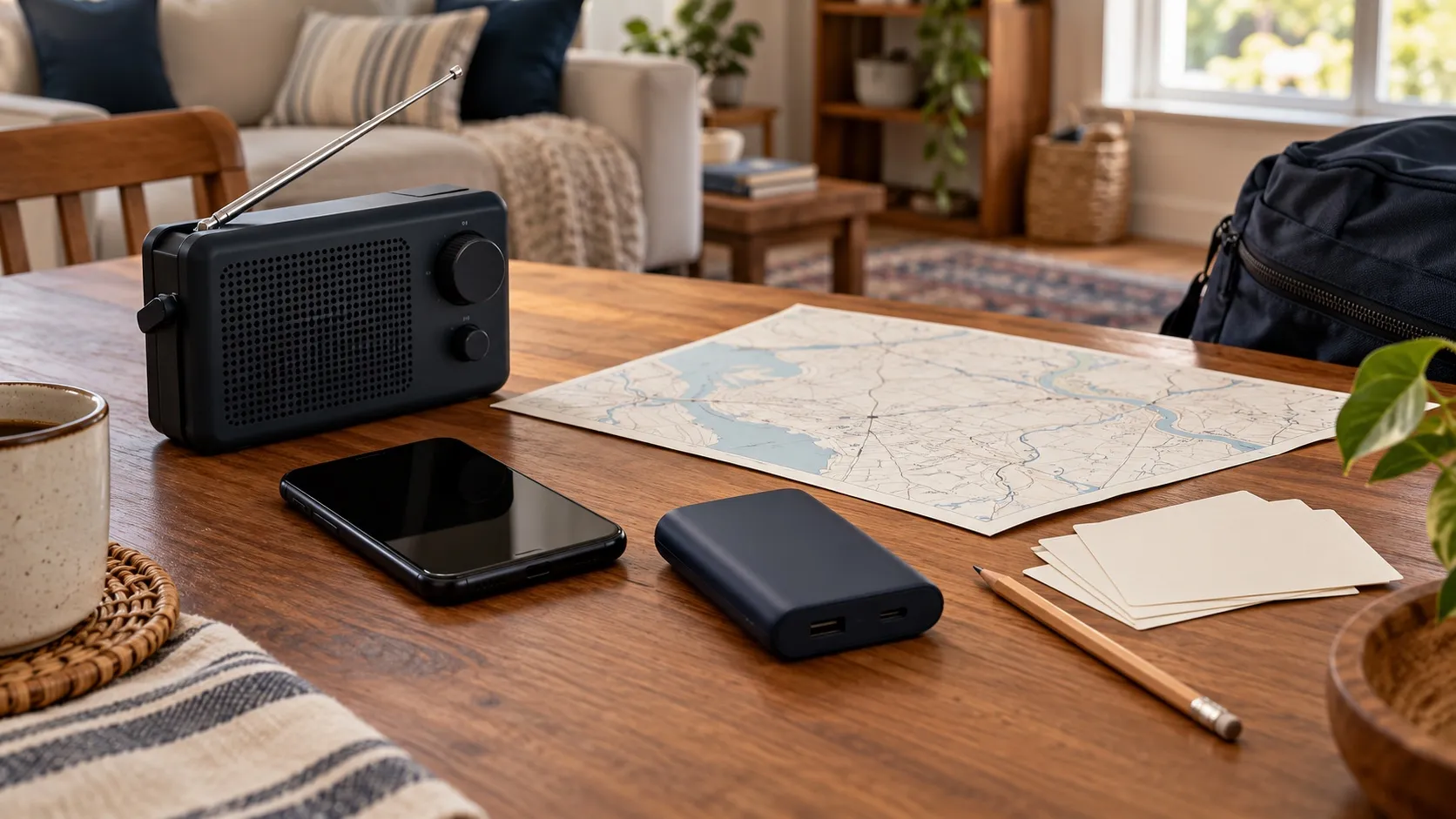
- a small local map when travel without navigation is possible.
Protect private information. Do not put sensitive medical, identity, or access details on a card likely to be lost.
Receive official information
Enable local emergency alerts where appropriate and follow the National Weather Service, local emergency management, transportation authorities, and the utility. Social posts can repeat outdated or location-specific information.
The Winter Storm Watch vs. Warning Guide explains alert terms and why the full local alert matters.
Add a power layer
Keep phones charged before expected weather, store compatible cables, and use a modest power bank for essential messages. Preserve battery by lowering brightness and closing unnecessary apps.
For an existing battery or power station, use the Battery Runtime Calculator with its rated capacity, actual running loads, target duration, and reserve and conversion-loss assumptions. A runtime estimate cannot confirm output, startup demand, or medical-device compatibility. Verify medical backup and continuity with the exact manual, device provider, and care team.
Practice a ten-minute winter check
- Send the short message to the relay contact.
- Find the paper card without using a phone.
- Confirm school, work, and care destinations.
- Name the warming location and travel trigger.
- Check that each person knows who will assist children, older adults, pets, or anyone with mobility needs.
Do not stage unsafe winter travel as a drill. Practice the communication while conditions are ordinary.
Keep the agreed message, contacts, meeting places, escalation step, and practice date on the protected paper plan. Use My Household Plan to mark the fixed communications checks for alerts, an out-of-area contact, and a paper copy; it does not store those private details.
Questions about household check-ins
What if mobile calls do not connect?
Try the agreed short text, preserve battery, and use the out-of-area relay contact when a message path is available. Follow official local alerts through another available layer, such as a battery radio. Do not repeatedly redial if doing so drains the only phone.
Do two-way radios replace official alerts?
No. They may support short-range household coordination, but range and permitted use vary. Follow current FCC rules for the radio service and keep an official alert source in the plan.
How often should the plan be updated?
Review it before winter and whenever school, work, care, address, phone, medical, transport, or household membership changes.
Adapt the plan for different household roles
Children and schools
Use the school’s official reunification process. Make sure authorized pickup contacts are current, and do not send a child toward a meeting place that conflicts with school instructions. Put the child’s full name, approved contacts, and essential medical information in the protected form the school requests.
Work and care locations
Ask how the workplace, adult day program, assisted-living setting, or home-care agency handles closures, transportation, and backup power. Record the number a household member should call and the point at which the facility becomes the temporary meeting location.
Pets and service animals
Decide who takes carriers, leashes, food, medication, and records. Use the Pet and Service Animal Emergency Plan for destination arrangements, care records, and applicable service-animal access rules.
Rural or low-coverage households
Document the areas where mobile service is normally unavailable, keep paper directions, and choose check-in times that do not assume continuous coverage. A radio may help locally, but it does not replace emergency services or official warnings.
Neighbors and support contacts
Share the minimum information needed for an agreed check-in. Do not publish access codes, detailed medical records, or a household supply inventory. If a person misses a check-in and immediate danger is possible, follow the escalation step written in the plan rather than improvising.