Build a Home Emergency Kit That Fits Your Household
A practical way to build, store, and maintain a home emergency kit without buying a pre-made bundle you will not use.
In this guideJump to a section
- The first layer: enough for a short disruption
- Build around the routines you already have
- Keep water separate from treatment plans
- Food that works when routines change
- A modest medical and first-aid setup
- Make communication boring and reliable
- Add a grab-and-go layer
- Maintain the kit without making it a project
- A final word on “complete”
- Questions about building the kit
Start with your real household
A kit is not a badge of preparedness. It is a small system that should work for the people, pets, medications, mobility needs, weather, and likely disruptions in your home.
There is no single “complete” emergency kit. An apartment household, an older adult who depends on refrigerated medicine, and a home with two dogs face different constraints. The useful common ground is simple: store the basics before a disruption, keep them easy to find, and make a short plan for what happens when a basic service is unavailable.
This guide builds the layered household kit: supplies for staying home, a portable evacuation layer, and smaller vehicle or workplace layers when they are useful. Its baseline follows Ready.gov emergency kit guidance and CDC emergency water guidance.
Build in layers. Get the first layer in place this month, then expand it as your budget and storage allow. You do not need to buy an expensive pre-made bundle to make meaningful progress.
The first layer: enough for a short disruption
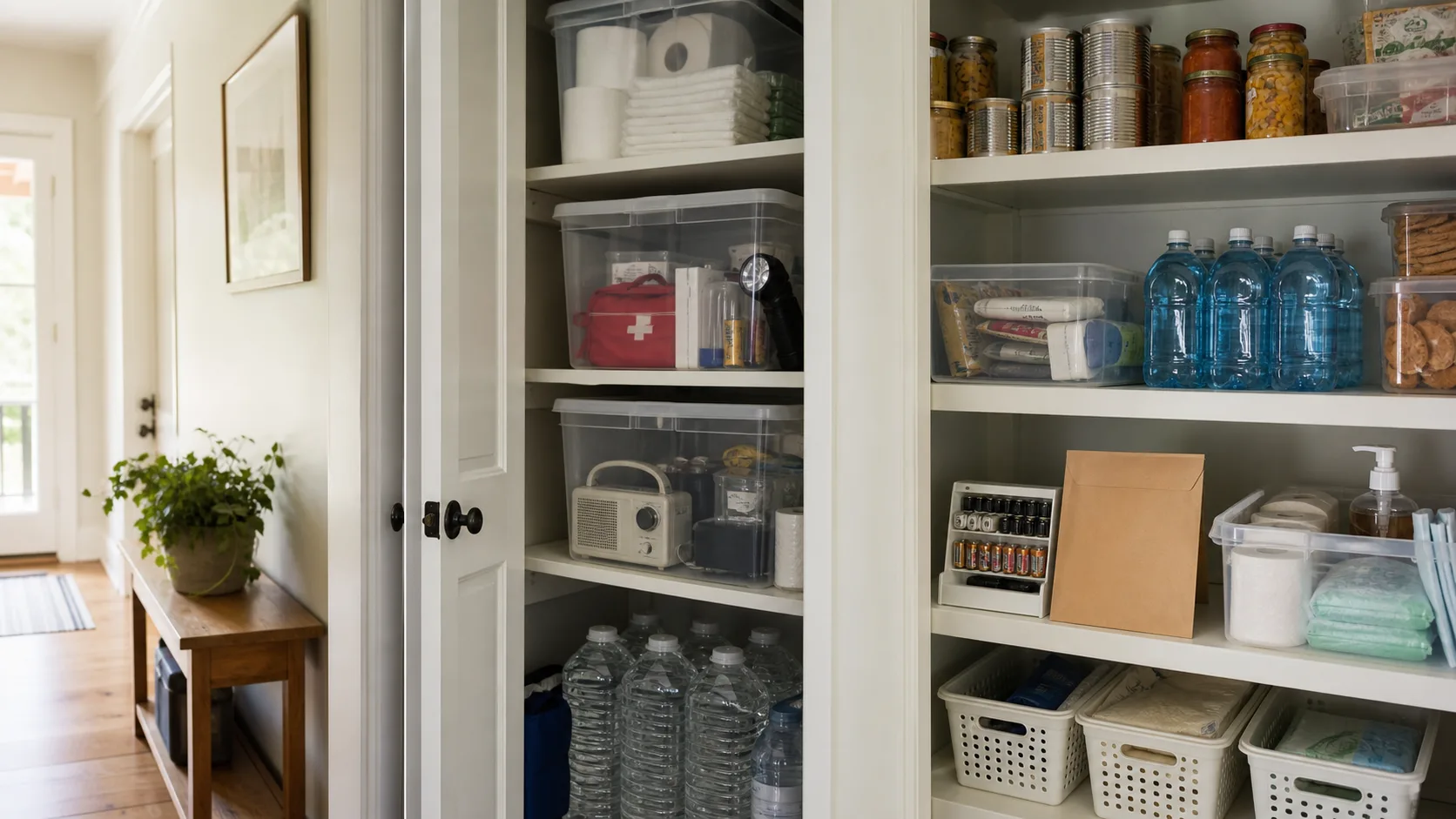
Begin with supplies that make a power outage, boil-water notice, or sudden need to stay home less stressful:
- Water: Store treated drinking water. The CDC baseline is at least one gallon per person per day, but heat, illness, nursing, and pets can increase needs. Write down the rate, duration, container weight, and refill plan.
- Food: Keep familiar, shelf-stable meals and snacks that fit your household’s dietary needs. Include a manual can opener and a way to prepare food if normal appliances are unavailable. Build the shopping list from actual meals.
- Medication and care items: Keep a current medication list, pharmacy and clinician contact details, glasses or mobility supplies, and the medical items your household uses. Ask a pharmacist or clinician about safe refill and storage options; do not make a medication plan from a generic checklist.
- Light and communication: Put a flashlight or headlamp, spare batteries or a charged power bank, and charging cables where everyone can find them. A battery-powered weather radio can be useful where official alerts are part of local emergency guidance.
- Documents and money: Keep copies of identification, insurance, emergency contacts, and key account information in a protected location. Include a little cash if that is practical for you.
- Sanitation and warmth: Add soap, toilet paper, trash bags, wipes, basic cleaning supplies, seasonal layers, and blankets appropriate for your home.
Choose a visible home for the kit
Use a labeled bin, cabinet shelf, or closet zone that adults in the household can reach. A kit hidden in the attic or behind heavy storage is not much help on a dark, rushed evening.
Build around the routines you already have
The best emergency supplies are usually the ones your household already knows how to use. Before purchasing anything specialized, walk through an ordinary day without electricity, running water, a working card reader, or mobile data. Note the first thing that becomes difficult.
| Household need | Useful question | Practical starting point |
|---|---|---|
| Drinking water | How much can we store and lift safely? | Several smaller, food-safe containers instead of one container no one can move |
| Food | What can we eat with the tools and fuel we have? | Familiar shelf-stable meals, a manual can opener, and a safe cooking plan |
| Medication | What cannot be interrupted? | A current list, contacts, and clinician-approved storage or refill plan |
| Information | How will we receive local instructions? | Emergency alerts enabled, a radio if relevant, and written contacts |
| Pets and children | What do they need that adults may overlook? | Food, water, medication, comfort items, and identification details |
| Mobility or sensory needs | What makes moving or communicating safer? | Required aids, batteries, chargers, and a person-directed access and support plan shared with caregivers |
Water storage baseline
Scepter Flow Control Water Can (WCG501)
Five-gallon (18.9 L) BPA-free food-grade HDPE container with an angled flow-control spout and air vent for home water staging. Store at floor level (~41.7 lb of water per can) and sanitize before filling.
- Listed water capacity
- 5 US gal
- Empty container weight
- Not verified in this source record
- Stacking when filled
- Not verified in this source record
Source records checked on 2026-10-04. This is research, not hands-on testing. Manufacturer source.
Review the model guideShelf-stable food tool
OXO Good Grips Soft-Handled Can Opener (SKU 28081)
Manual gear-driven can opener with cushioned handles and a built-in bottle-cap opener for shelf-stable pantry meals during a power outage. Test on the exact cans in your pantry before storing.
- Opening method
- Manual rotary can opener with large cushioned handles and an oversized turning knob.
- Listed dimensions
- 7 × 2 × 3 in
- Manufacturer care instructions
- Hand wash the can opener.
Source records checked on 2026-10-04. This is research, not hands-on testing. Manufacturer source.
Review the model guideNOAA weather alert radio
Midland ER310 Portable Emergency Crank Weather Radio (US, non-PRO model)
Multi-power AM/FM and NOAA weather alert radio with a 2,600 mAh rechargeable Li-ion cell, AA alkaline backup bay, hand crank, solar trickle panel, and CREE LED flashlight. Confirm NOAA coverage at your address and keep fresh AA cells staged.
- Radio bands
- NOAA Weather Radio, AM, and FM
- Weather-alert behavior
- Weather alerts on the selected local weather channel
- Backup cells
- Six AA cells; not included and not rechargeable in the radio
Source records checked on 2026-10-05. This is research, not hands-on testing. Read the manufacturer manual.
Review the model guideHands-free kit lighting
Black Diamond Spot 400 Headlamp, black, SKU BD6207320002ALL1 (US)
Compact 400-lumen IPX8 waterproof headlamp (3.0 oz with batteries) with Dual-Fuel power (three AAA cells or optional BD 1500 battery) and a mechanical lock mode for go-bags. Store AAA alkaline cells outside the housing during long storage.
- Listed light output and modes
- 400 lm maximum; 200 lm medium; 6 lm low
- Power source
- Three AAA batteries included or separately sold BD 1500 rechargeable Li-ion battery
- Listed weight
- 86 g with AAA or 72 g with BD 1500 battery
Source records checked on 2026-10-05. This is research, not hands-on testing. Read the manufacturer manual.
Review the model guideKeep water separate from treatment plans
Stored drinking water is the dependable first line. Filters, tablets, and boiling can be useful backups, but they are not interchangeable and may not make every source safe. Floodwater, unknown runoff, and damaged plumbing can contain hazards that require more than a portable treatment method.
Use clean, food-safe containers; label the fill date; and follow local public-health direction during an incident. If a water utility issues a boil-water or do-not-use advisory, follow that advisory rather than relying on a generic rule of thumb.
For quantities, start with the household’s recorded drinking and food-preparation baseline, then decide whether to add a reserve for hygiene, heat, illness, or pets. Keeping pet water visible in your plan prevents it from disappearing into the household total.
Food that works when routines change
Emergency food does not need to look like survival rations. A few days of meals your household eats normally is easier to rotate and far more likely to be useful.
Prioritize:
- foods that meet allergies, cultural preferences, and medical needs;
- meals that require little or no water and can be eaten without cooking when necessary;
- infant, child, and pet supplies where relevant;
- a clear rotation date on the bin or shelf; and
- a safe plan for refrigerator and freezer food during an outage.
Avoid treating a camp stove, grill, or generator as an indoor appliance. Never use a camp stove or grill indoors; operate a generator outdoors, more than 20 feet from windows, doors, and vents, and use a battery-powered or battery-backup CO alarm. See the CDC’s carbon-monoxide guidance for the placement and alarm limits.
A modest medical and first-aid setup
A home kit should support ordinary first aid and help you communicate clearly with professionals. It is not a substitute for training or emergency medical care.
Consider basic bandages, gauze, tape, gloves, antiseptic supplies, a thermometer, and any household-specific items you already know how to use. Add written information: allergies, conditions, medications, doses, insurance details, clinicians, and emergency contacts. A current first-aid or CPR course is more valuable than adding unfamiliar advanced equipment.
Call emergency services for severe injury, trouble breathing, chest pain, uncontrolled bleeding, overdose, or any other immediate medical emergency. MedlinePlus’s emergency-warning guide lists additional signs; this general information is not a diagnosis. If someone depends on powered medical equipment or refrigerated medication, make that contingency plan with their care team before an outage.
Make communication boring and reliable
Write down the numbers and meeting details you normally keep in your phone. Agree on an out-of-area contact if your household could be separated. Keep a printed local map if you may need to travel without dependable navigation.
For a clear, small plan, see how to build a household communication plan. The goal is not to collect gadgets; it is to know who checks on whom, where to meet, and how to receive official instructions.
Add a grab-and-go layer
Home supplies and evacuation supplies overlap, but they should not be the same container. A small bag near the exit can hold copies of documents, medications, chargers, water, snacks, a change of clothes, hygiene items, and household-specific essentials. Keep it light enough for the person expected to carry it.
Update it when a child outgrows clothing, prescriptions change, a pet joins the household, or your address and contacts change.
Before treating the bag as finished, use a suitable scale and the kit-weight planning method to weigh packed categories. The kit calculator totals entered weights and its water-volume estimate; test the actual bag on the planned route. The intended carrier, stairs, transit, weather, mobility aids, children, and animal supplies matter more than a generic bag-weight rule.
Maintain the kit without making it a project
Put two short check-ins on the calendar each year, perhaps when daylight saving time changes or before your local severe-weather season. In ten minutes, you can:
- Check water containers for leaks, labels, and storage conditions.
- Rotate food you will use soon and replace it with items you already eat.
- Charge power banks and test flashlights, radios, and alarms.
- Update medication lists, documents, emergency contacts, and pet information.
- Talk through the plan with everyone in the household.
Once the supplies are in place, write down when your household will stay, leave, or move to a safer location. Include separate water planning for pets and any care needs that change the baseline.
A final word on “complete”
Preparedness is not a finish line. It is a set of small, maintained choices that gives your household more time and clarity when normal services are disrupted. Start with what is likely, affordable, and useful to you. Then improve it as you learn what your household actually needs.
Questions about building the kit
How much should I spend on an emergency kit?
Start with what you can add gradually. Water, food you already eat, basic light, copies of documents, and a written plan usually do more than a large one-time purchase of unfamiliar gear.
Should every person have a separate kit?
Keep shared home supplies together when that makes access easier, but give each person a simple grab-and-go layer for essential medication, comfort items, clothing, and identification. Adapt this for children, older adults, and anyone with mobility or sensory needs.
How often should I check my emergency supplies?
Twice a year is a manageable starting rhythm, with an extra check before local fire, hurricane, winter-storm, or monsoon seasons when those are relevant.
When the first layer is in place, use the 50 Emergency Supplies Checklist to fill only the gaps your household has identified. Keep owners, locations, and review dates on a private kit-maintenance sheet; mark corresponding fixed kit checks in My Household Plan.