How to Compare Freeze-Dried Meal Brands
Compare freeze-dried emergency meals by usable portions, water and fuel demand, allergens, sodium, package dates, storage instructions, and household fit.
In this guideJump to a section
- Step 1: define the job
- Step 2: compare usable calories
- Step 3: audit water and fuel
- Step 4: screen the ingredient and nutrition labels
- Step 5: verify storage and date claims
- Step 6: run a small household test
- Step 7: compare the current candidates
- Common buying errors
- Where specialty meals fit
- Primary safety sources
- Your next step
Brand rankings age quickly. Recipes, package sizes, prices, availability, and label claims can change without notice. A safer way to choose freeze-dried emergency meals is to compare the exact packages available to you, then test a small quantity before buying a case.
This guide does not declare a universal winner. It gives you a repeatable label audit that works across brands and product lines. Build the ordinary pantry first with emergency food storage basics, then use specialty meals only where their low weight, compact storage, or convenience solves a real problem.
Step 1: define the job
Freeze-dried meals can serve different purposes:
- a few morale meals in a two-week home pantry
- compact food in a vehicle or evacuation kit
- quick meals when outdoor cooking time is limited
- a deeper reserve after familiar foods are already covered
The job determines the right package. A lightweight pouch may suit evacuation but be expensive for a large household pantry. A bulk can may have a lower unit cost but create leftovers and require careful resealing after opening.
Use the food storage calculator to estimate the broader need. Do not use the number of packages or the word “servings” on the front label as a substitute for a household menu.
Step 2: compare usable calories
Record three numbers from the current Nutrition Facts panel:
- calories per labeled serving
- servings per container
- calories in the entire container
Then decide whether the entire container is one realistic meal for the people using it. Marketing serving counts may describe small portions that do not match an adult meal, while some pouches may contain more food than one person can safely use without refrigeration.
Calculate cost per usable meal from the price you can actually buy, including shipping or membership fees. Also calculate cost per 1,000 calories if you are comparing products with very different portion sizes. These calculations are shopping tools, not nutritional prescriptions.
Step 3: audit water and fuel
Write the exact water quantity and preparation time beside each candidate. Multiply it by the number of packages in your menu. A case of convenient meals can consume a meaningful amount of stored water.
The CDC recommends at least one gallon per person per day for three days, with a two-week supply encouraged where possible. That water supports drinking, cooking, brushing teeth, and other uses. Meal preparation must fit inside the full water plan.
Check whether the package needs boiling water or merely hot water, whether it can be prepared with room-temperature water according to the manufacturer, and how long it must stand. Never improvise a method that conflicts with package directions.
Step 4: screen the ingredient and nutrition labels
Read the exact package every time, even if you bought the same flavor before. Review:
- major allergens and cross-contact statements
- sodium per serving and per whole package
- protein and fiber in the planned portion
- ingredients a household member cannot or will not eat
- preparation instructions and safe-water requirements
- whether a medical diet makes the product inappropriate
People with kidney disease, heart conditions, diabetes, food allergies, or other clinical nutrition needs should ask an appropriate healthcare professional about emergency options. A long shelf life does not make a meal suitable for every person.
Step 5: verify storage and date claims
Use the shelf-life, best-by, and storage information printed on the package or published by the manufacturer for that exact product. Do not transfer a claim from one product line, package type, or review to another.
Before buying, ask:
- Is the date measured from manufacture or purchase?
- What storage conditions does the claim require?
- Is the package intact and clearly dated?
- What does the manufacturer say about storage after opening?
- Can you keep it away from moisture, pests, sunlight, chemicals, and temperature extremes?
Shelf-life language usually addresses product quality under stated conditions. It does not excuse damaged packaging or unsafe preparation water. Inspect packages during pantry reviews and follow manufacturer instructions.
Step 6: run a small household test
Buy one or two candidate meals before purchasing a case. Prepare them with the exact stove, pot, water measure, and utensils you plan to use during an outage.
Score only what you can observe:
| Check | Question |
|---|---|
| Instructions | Could someone prepare it correctly in low light? |
| Water | Did the measured amount produce the expected texture? |
| Time | Did preparation match the label? |
| Portion | Was one package a realistic meal? |
| Acceptance | Would the intended person willingly eat it again? |
| Cleanup | Did it require extra water or cookware? |
Do not publish a taste opinion as a universal fact. Record your household’s result and keep the product only if it works for the people who will use it.
Step 7: compare the current candidates
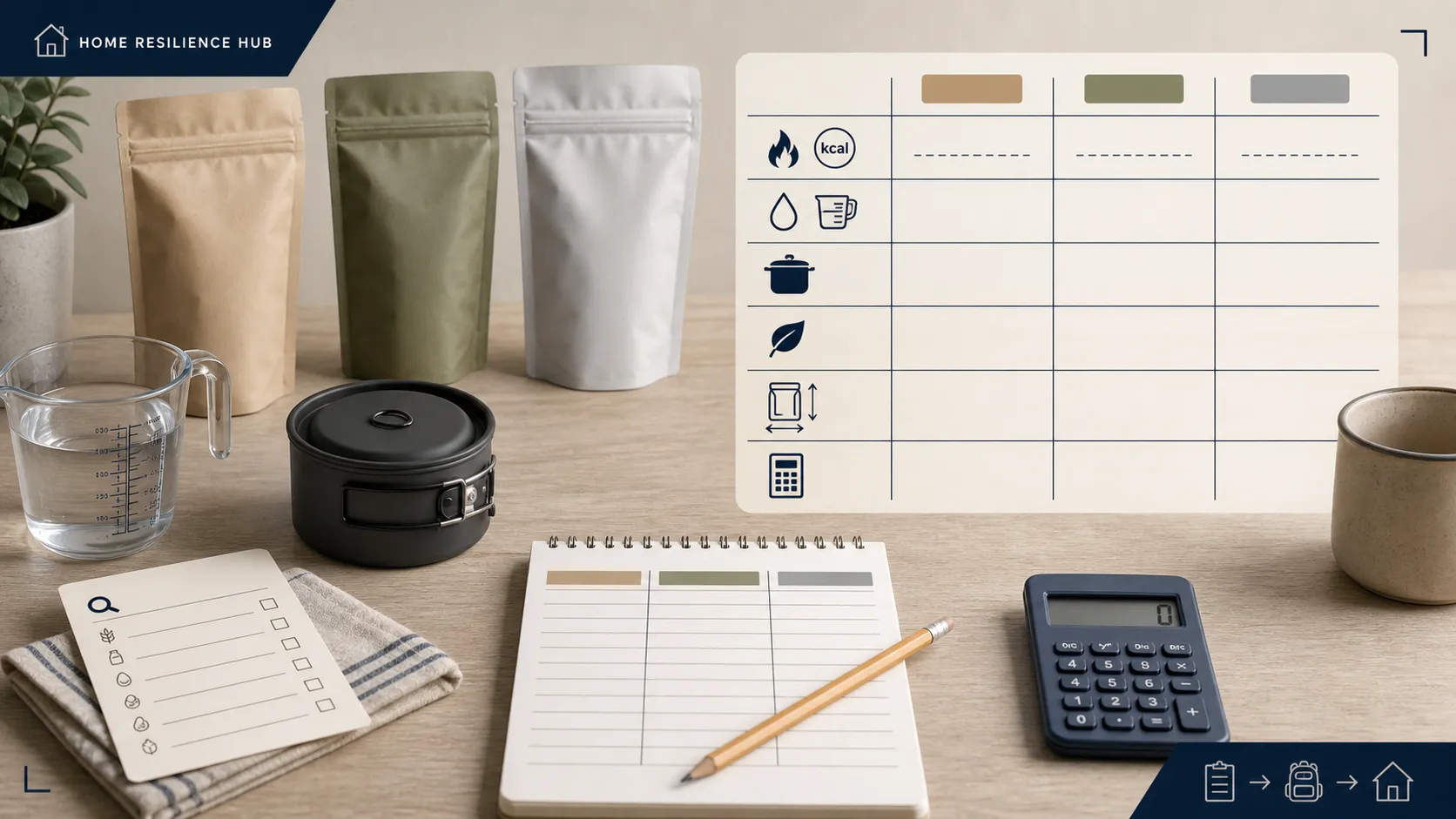
Use a spreadsheet or paper table while shopping:
| Product | Whole-package calories | Usable meals | Water | Allergens | Sodium | Package date | Current total cost |
|---|---|---|---|---|---|---|---|
| Candidate A | label | household estimate | directions | label | label | package | receipt |
| Candidate B | label | household estimate | directions | label | label | package | receipt |
| Candidate C | label | household estimate | directions | label | label | package | receipt |
Recheck the table at purchase time. A comparison from last year cannot establish today’s price, formulation, package size, or availability.
Common buying errors
- Buying by serving count: Use calories and realistic household portions instead.
- Ignoring preparation water: Count water for every planned package.
- Buying a case before tasting: Test a small quantity with the intended users.
- Choosing only entrees: Make sure the complete menu covers breakfasts, snacks, and no-cook options.
- Treating one date as a guarantee: Follow the exact package’s storage and inspection guidance.
- Forgetting open-package handling: Bulk containers may not fit a short outage or small household.
Where specialty meals fit
Freeze-dried food is one tool within a layered pantry. It should not crowd out stored water, a manual can opener, ordinary shelf-stable meals, medication, or a safe cooking plan. Place selected meals into the two-week menu and test the complete day.
Primary safety sources
- FoodSafety.gov: Food Safety in a Disaster or Emergency
- CDC: How to Create an Emergency Water Supply
- Use the current Nutrition Facts, ingredient, allergen, storage, and preparation labels on each product being considered.
Your next step
Compare two exact packages with the table above, then prepare one candidate with the stored water, equipment, and intended eater before buying a case.
Keep this guide handy
Save it to Pinterest, copy the page address, or send it to someone in your household.